
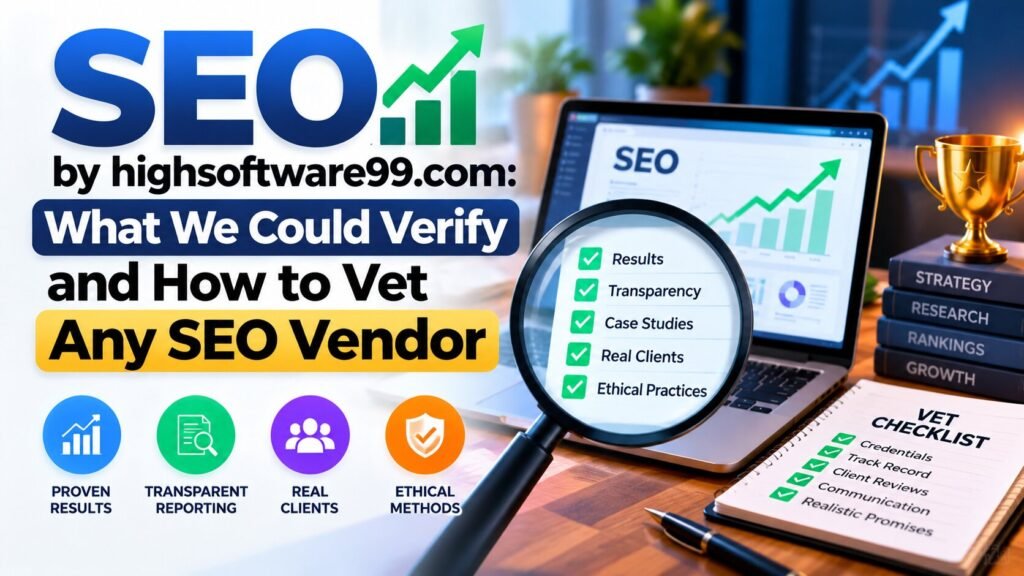
If you landed here after searching for SEO by highsoftware99.com, you probably want one thing: a straight answer on whether it’s worth your time or your clients’ money.
Here’s the short version. When we looked, we found a lot of near-identical articles about the name and very little hard evidence about the business behind it. That doesn’t prove anything either way. It does mean you should check before you buy, and especially before you resell or white label anything from a vendor you can’t verify.
This guide covers what the search results actually show, what we could and couldn’t confirm, and a practical process agencies can use to vet any SEO, guest post, or link building supplier. It’s written for agency owners and SEO consultants who outsource fulfillment under their own brand and can’t afford a bad link going out with a client’s name on the report.
What People Mean When They Search for SEO by highsoftware99.com
The phrase shows up in a few different forms: “seo service highsoftware99.com,” “seo instant appear highsoftware99.com,” and plain “highsoftware99.” Searchers are usually in one of these camps:
- They saw the domain in an ad, message, or post and want to know if it’s legitimate.
- They’re comparing SEO providers and want reviews or pricing.
- They saw a claim about fast rankings and want to know if it holds up.
- They can’t remember the exact URL.
That mix of navigational, commercial, and “is this legit” intent is why a neutral, evidence-first page is more useful here than a sales pitch. Anyone writing about this name without checking the facts is guessing.
What We Could and Couldn’t Verify
Here’s what a basic check turned up. Treat it as a starting point and repeat the checks yourself, because websites change.
| Question | What we found |
|---|---|
| Does the official site explain the service? | The site loads as a JavaScript app. Our automated check could only read a default page title, so we couldn’t confirm what it shows to a visitor. Open it in a browser and look for yourself. |
| Is there a named team, address, or company registration? | We couldn’t confirm one from the pages we reviewed. |
| Are there client case studies with real, checkable results? | None found in the material we reviewed. |
| Is there published pricing? | Some third-party articles mention “affordable” or “no hidden costs,” but we found no pricing you could verify. |
| What do third-party articles say? | Many near-duplicate pages on obscure domains describe it in broad, generic terms. Some call it a service, one describes it as a branded label for common SEO principles, and others call it an “approach.” They don’t agree with each other. |
The pattern matters more than any single page. When a dozen articles repeat the same vague claims, use the same headings, and cite no clients or data, that’s usually content produced to catch a search term, not independent reporting. Independent coverage tends to name people, show results, and disagree with itself a little.
Why the keyword gets so much attention
Ranktracker published an analysis of the search data around this name. It estimates that one third-party article ranking for the phrase draws roughly 31,200 organic visits a month, with about 79% of that traffic from India and 21% from the United States. The same piece is careful to say these are third-party estimates, not direct analytics, and that content about the name should avoid unsupported claims about the quality, legitimacy, or speed of the service.
That’s the right attitude. A keyword with big search volume tells you people are curious. It doesn’t tell you the service delivers.
Red Flags to Watch for With Any SEO Vendor
You don’t need to decide anything about one specific brand to use this list. It works on every vendor pitch you get.
- Promises of instant or guaranteed rankings. Nobody outside Google controls rankings. Phrases like “instant appear” should make you slow down.
- No named people. If you can’t find who runs the business or who will do the work, you can’t hold anyone accountable.
- No case studies you can check. Screenshots without a client name, date range, and source (Search Console, an analytics export) are decoration.
- Vague deliverables. “Boost your visibility” is a slogan. “Five guest posts per month on sites in your niche, with live URLs and traffic screenshots” is a deliverable.
- Pricing that hides the unit. Ask what one link or one placement costs, and what happens if it’s removed.
- Everything is measured in DA or DR. More on that below.
- A pile of generic reviews. Look for reviews on platforms the vendor doesn’t control.
How to Evaluate a Guest Post or Link Building Supplier
If a vendor is offering links, this is where the real due diligence happens. Agencies often get burned here because the pitch sounds the same whether the links are great or terrible.
Start with Google’s own rules
Google’s spam policies define link spam as links created to or from a site primarily to manipulate rankings. The examples include buying or selling links for ranking purposes, excessive link exchanges, and using automated programs to create links to your site. It’s worth reading the page in full before you sign any contract that involves links.
Paid or sponsored placements aren’t automatically off limits, but they need to be marked correctly. Google’s guidance on qualifying outbound links says paid placements should carry the sponsored value, and that other links the publisher doesn’t want to vouch for can use nofollow. Google has also said that publishing or acquiring links through excessive sponsored and guest posting without proper link tags can lead to algorithmic or manual action. So a vendor who promises “100% safe” links is either misinformed or not being straight with you.
Judge the publisher, not just the number
Third-party scores like DA, DR, and DF are useful for quick filtering. They aren’t Google ranking factors, and a high score doesn’t make a site a good place to publish. Check these instead:
- Topical relevance. Does the site actually cover your client’s subject, or does it publish on everything?
- Real organic traffic. Look at the traffic trend over time. A sudden spike or a cliff is a warning.
- Editorial standards. Are posts edited, or does anything with a link get published? Check how the existing posts read.
- Outbound link patterns. If every article links out to unrelated commercial sites, your link sits in a bad neighborhood.
- Audience fit. Would a real person in your client’s market read this site?
- Placement. A link inside a relevant paragraph of a useful article beats a link in a footer or author box.
- Anchor text. Natural, varied, mostly brand and topic related. Exact-match anchors on every post is a pattern, and patterns get noticed.
What metrics can and can’t tell you
Metrics help you compare options. They can’t tell you whether a page will pass value, whether the site will still exist in two years, or whether Google trusts it. Use them to shortlist, then read the site like a human.
A Pre-Purchase Checklist for Agencies
Before you outsource guest post or link building fulfillment to anyone, get answers to these:
- Who exactly does the outreach and writing, and can I speak to someone?
- Can I see the publisher list or approve sites before anything goes live?
- Will every placement be a live, indexable URL I can verify?
- How are paid or sponsored placements labeled?
- What happens if a link is removed or the page is deindexed?
- What does a typical report look like, and does it show live URLs?
- Do you allow white label reporting under my agency’s brand?
- What are the content standards, and who owns the content?
- Can I start with a small paid test before committing to a bundle?
- How is turnaround handled when a publisher is slow?
A good vendor answers these without getting defensive. A weak one answers with adjectives.
When Outsourcing Guest Post Fulfillment Makes Sense
Outsourcing tends to pay off for agencies when:
- Prospecting and outreach are eating hours your team should spend on strategy.
- You’re selling links as part of retainers but don’t want to maintain publisher relationships.
- Client volume is growing faster than your capacity.
- You want a repeatable process with consistent reporting.
It makes less sense when you have a tiny, tightly controlled link program where you personally vet every placement, or when you can’t get transparency from the supplier.
If you do decide to outsource, look for a partner that shows its work: named publishers or approval controls, live URLs, clear labeling, and honest answers about risk. That’s the standard we hold ourselves to at backlinksolutions.net, where agencies can use our guest post and white label link building services as an extension of their own team. Whatever supplier you choose, run the checklist above first.
FAQs
Is SEO by highsoftware99.com legitimate?
We couldn’t verify it. We found no checkable company details, client results, or published pricing in the material we reviewed, and the third-party articles about it are generic and inconsistent. That isn’t proof of anything negative, but it’s a reason to ask for evidence before paying.
Why do so many articles about it look the same?
When a search term gets traffic, publishers produce articles to rank for it. Those pages often repeat the same generic claims without original reporting. Look for articles that name people, show results, or cite sources.
Can any SEO service guarantee instant rankings?
No. Google decides rankings and nobody outside Google controls them. Timelines vary with competition, site quality, and content. Treat any promise of instant or guaranteed placement as a red flag.
Is paying for guest posts against Google’s guidelines?
Google’s spam policies list buying or selling links for ranking purposes as link spam. Paid or sponsored placements should be marked with the appropriate rel attribute. Many agencies treat guest posting as a content and exposure channel first and a link source second, and keep placements editorial and relevant.
Does a high DA or DR mean a site is a good guest post target?
Not by itself. These scores come from third-party tools and aren’t Google ranking factors. Relevance, real organic traffic, editorial quality, and outbound link patterns tell you more.
How can I check a vendor’s results?
Ask for live URLs, dates, and client permission to contact a reference. Verify the links yourself, check indexing, and compare traffic trends in a tool you trust.
Conclusion
There’s plenty of noise around SEO by highsoftware99.com and not much evidence you can check. Whether it turns out to be a real service or just a popular search term, the same discipline applies to any vendor: demand named people, live results, honest labeling, and publisher quality you can inspect.
If you’re an agency looking for a transparent way to scale guest post and link building fulfillment, you can talk to us at backlinksolutions.net about a small test order and see how our process works before you commit to anything bigger.