
“We need ten backlinks a month” sounds like a clear client request. It leaves out almost everything that matters: which pages need support, what kind of publication would make sense, who approves the content, and what the client expects to happen afterward.
Those gaps tend to show up later as rejected sites, slow approvals and awkward report calls. Good guest post link building for clients starts by closing them before anyone sends a pitch.
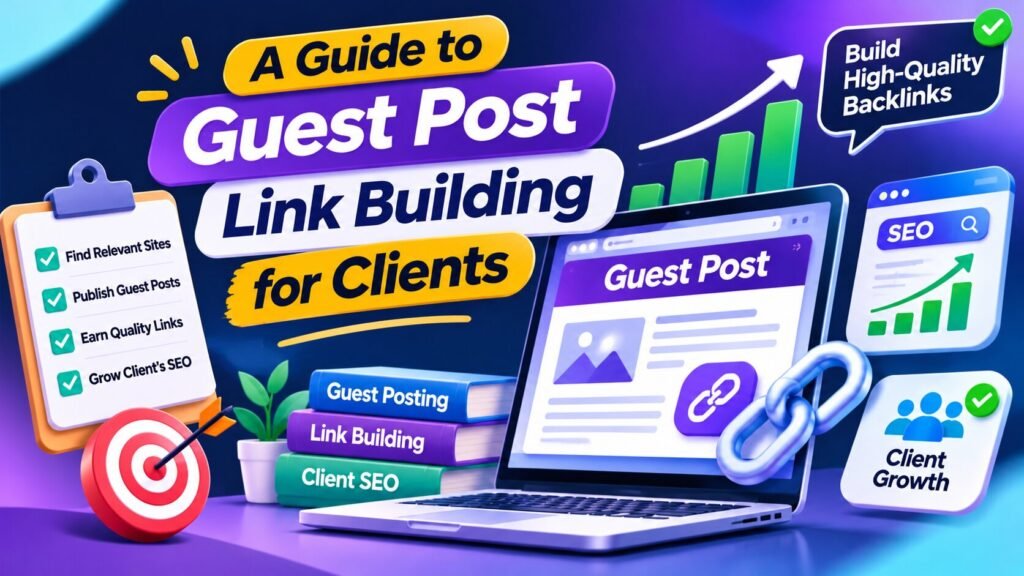
This guide walks agencies and consultants through the full job: deciding whether guest posting fits, planning the campaign, vetting publishers, running outreach, controlling content, budgeting, reporting and choosing when to outsource. You’ll also find a sample plan and a checklist you can adapt for your next account.
What is guest post link building for clients?
It’s the work of getting articles published on other websites on a client’s behalf, where the article includes a relevant link back to the client. An agency may handle the pitching and writing itself or pass some of it to a supplier.
A good placement can introduce the client to a new audience, send referral visits and show their expertise. The effect of its link on search performance depends on many things, including how the link was obtained. No single post comes with a predictable ranking result.
Start with Google’s rules
Google’s spam policies define link spam as creating links primarily to manipulate search rankings. Examples include buying links for ranking purposes and using optimized anchor text in guest posts distributed on other sites. Creating low-value content mainly to manipulate links is listed too.
Paid advertising and sponsorship links are allowed when they’re qualified with rel="sponsored" or rel="nofollow". If your campaign pays publishers, say so to the client, require the right attribute and don’t sell those links as a way to pass ranking credit. An unpaid pitch can still be a problem if the article exists mainly to manipulate rankings.
Check whether the client is a good fit
Guest posting isn’t the right next step for every account. Run this check first.
| Question | Ready to proceed | Fix or rethink first |
|---|---|---|
| Is there a page worth referencing? | A useful guide, tool, study or clear service resource | Only thin or duplicated pages |
| Can the site serve new visitors? | Key pages load, work on mobile and can be indexed | Broken pages or unresolved indexing problems |
| Is there something to say? | Subject experts, customer questions or original information | No access to expertise and little to add |
| Are relevant publications available? | Real sites serve the client’s buyers or their industry | The only options are unrelated general sites |
| Can the client approve work? | One contact and an agreed response time | Several reviewers with no final decision maker |
| Are expectations realistic? | The client accepts uncertainty | The contract depends on guaranteed rankings |
If the right-hand column describes the account, spend the first month on content, technical fixes or positioning. That’s easier to defend than a batch of links pointing to pages that aren’t ready.
Plan the campaign before prospecting
Pick one main goal
Link building for SEO clients often gets reduced to a monthly link count. A count tracks output, so pair it with the reason for the work.
| Main goal | Publication to prioritize | What to track |
|---|---|---|
| Reach potential buyers | Trade publications and specialist blogs | Referral visits, engaged sessions, assisted enquiries |
| Show subject expertise | Sites with named contributors and strong editing | Accepted topics, mentions, follow-up invitations |
| Support organic visibility | Relevant publications where a reference is editorially justified | Qualifying links, plus target page search trends |
| Enter a new market | Publications serving that country and language | Relevant referral traffic by market |
Search trends are worth watching, but other changes affect them too. Don’t credit every movement to the guest post.
Choose target pages
Ask what a reader would want after reaching the relevant paragraph. Often the answer is a guide, calculator or research page. A homepage may suit a brand mention, and a service page can work when the context supports it. Internal links from a useful resource can then guide visitors to commercial pages.
Build a one-page client brief
Collect these before work starts:
- The client’s products, buyers, locations and languages.
- Main goal and priority pages.
- Topics their experts can speak about with confidence.
- Claims that need evidence, legal review or approval.
- Competitors, publishers and subjects to exclude.
- Preferred brand name, author details and approved credentials.
- Payment, disclosure and link attribute rules.
- Budget, reviewer, response deadline and reporting date.
A sample 90-day plan
This hypothetical plan is for a company selling inventory software to independent restaurants. Treat the timing as a planning aid, because publishers set their own pace.
| Period | Agency work | Checkpoint |
|---|---|---|
| Days 1 to 15 | Interview the client, review target pages and agree on rules | Signed brief |
| Days 16 to 30 | Build a publisher shortlist and develop topics on food waste and stock counts | Approved sites and angles |
| Days 31 to 60 | Pitch, follow up and draft accepted topics | Editor responses and drafts |
| Days 61 to 90 | Complete edits, check live posts and review what worked | Placement report and next-quarter decision |
Some posts may still be waiting for publication on day 90. Report them as pending.
How to vet publishers
Build your shortlist from places the client’s buyers might actually read. Industry publications, associations, specialist newsletters with web archives and complementary businesses are good places to look.
Then review each site in two passes.
Pass one: reasons to reject
Set these aside quickly:
- Unrelated topics published side by side with no clear audience.
- Recent posts that are repetitive, inaccurate or barely edited.
- Frequent exact-match commercial links to unrelated businesses.
- Hacked pages, deceptive redirects or intrusive spam.
- A payment arrangement that conflicts with the campaign’s disclosure or link rules.
Pass two: score what’s left
This is a suggested internal scorecard. The weights are a starting point and have no connection to how Google ranks pages.
| Factor | What to examine | Points |
|---|---|---|
| Audience and site relevance | Do the readers overlap with the client’s market? | 30 |
| Editorial quality | Are articles accurate, original and edited with care? | 25 |
| Topic and page fit | Is there a natural angle and a reason to reference the client? | 20 |
| Organic visibility | Do relevant pages and markets appear to attract search visits? | 15 |
| Transparency | Are ownership, contributor rules and commercial terms clear? | 10 |
For example, you might require 70 out of 100, plus at least 20 points for audience relevance. Adjust the thresholds after reviewing real results. A high total should never override a rejection reason.
DA, DR and traffic estimates can help you sort a long list. They’re third-party figures, not direct Google ranking factors. A high-scoring domain can publish a weak page, and traffic to unrelated articles may mean little for your client. Check which pages and countries drive the estimate and look at the trend over several months.
Run outreach that gives editors a reason to reply
Read the contributor guidelines and a few recent articles. Find the right editor, verify the address and pitch an idea that fits a gap you can explain.
A useful pitch contains:
- A specific subject line.
- One sentence showing why the idea suits their readers.
- One to three possible topics with a short outline.
- The expertise or evidence the writer can bring.
- An honest note about who you represent.
Here’s a sample for the restaurant software client:
Subject: Article idea: why restaurant stock counts drift
Hi [Editor name], I work with [Client], which makes inventory software for independent restaurants. Would your readers find a practical piece on why stock counts stop matching what’s on the shelf useful? It would cover unit conversions, unrecorded waste and delivery checks, with input from [Client expert]. I can send a short outline if it fits your plans.
Use the client’s name only with permission, and never invent a relationship or credential. Send a polite follow-up if appropriate, and stop when someone declines or asks you not to contact them. Check the email marketing and privacy rules that apply to the people you contact.
Estimate outreach capacity honestly
Plan around the whole outreach funnel, because most sends may never turn into a placement. Point Visible’s outreach data from its own operation reported a 9.1% any-reply rate and a 2.5% positive-reply rate for guest post proposals. Its total of more than 3,945 sends includes other pitch types too, with reply cohorts measured from February to July 2026. “Any reply” can include automated responses.
At a 2.5% positive rate, the average works out to one positive reply for every 40 sends. Ten positive replies would imply about 400 sends. A positive reply also isn’t a published post, and the report gives no placement rate.
This is one agency’s self-reported data, and its summary figures shouldn’t be treated as a forecast. Your niche, list quality, offer and sender reputation can change the result. Track your own numbers at each stage: sent, replied, interested, accepted, drafted and published.
Control content, links and approvals
Give the article a job
Each draft should help the publisher’s reader solve a problem or understand something better. Interview a client expert, even briefly. Ask what customers get wrong, what usually causes the problem and when the common advice fails. Those answers give a writer material that a keyword brief can’t.
Before sending a draft, confirm that:
- It follows the publisher’s guidelines.
- Facts and statistics have reliable sources.
- Quotes, authors and credentials are real and approved.
- The article is original and useful without the client link.
- Any AI-assisted work has been checked by a knowledgeable editor.
- Commercial relationships are disclosed as required.
Let anchor text follow the sentence
Suppose the target is a guide to counting restaurant inventory. “A weekly stock count checklist” tells readers what they’ll find. Forcing “best restaurant inventory software” into the same sentence changes the meaning and reads like an advert.
Brand names, page titles and descriptive phrases can all work. Review anchors across the whole campaign for repetition. There’s no anchor percentage that makes a paid or manipulative link safe.
Set approval deadlines
Agree on who approves the site list, topic, draft and target link. Give each step a deadline and decide what silence means. For health, finance, legal and other sensitive subjects, don’t treat silence as approval.
An editor may change your headline or anchor, or remove a link. Tell the client early that the publisher controls its own site.
Budget and price the work
BuzzStream’s link building pricing data, updated October 20, 2026, puts the average guest post at $295 bought directly from a site and $461 through a vendor. These marketplace averages aren’t a quote or a sign of quality, and they don’t price earned, unpaid outreach. Industry and site traffic can move the cost a lot.
Work backward from the client’s budget. Here’s a hypothetical $3,000 monthly campaign aiming for a 40% gross margin. It assumes six internal hours at $60 per hour and uses the vendor average for supplier cost.
| Budget line | Amount (USD) |
|---|---|
| Client fee | $3,000 |
| Maximum delivery cost at a 40% margin | $1,800 |
| Internal strategy, review and reporting | $360 |
| Left for supplier fees | $1,440 |
| Three placements at $461 | $1,383 |
| Total delivery cost | $1,743 |
That leaves a gross margin of about 41.9%. A fourth placement at the same price would push delivery cost to $2,204 and cut the margin to about 26.5%, before extra review time. This budget therefore supports three at these assumptions.
Your scope should also say whether the client is buying effort, such as research and pitching, or a number of accepted placements. With effort-based work, define activity and reporting. With placement-based work, define acceptance criteria, deadlines and what happens if the target is missed. Pressure to hit a fixed count shouldn’t lower the publisher standard.
Report results the client can understand
Split the report into three parts.
1. Work delivered. List each live URL, date, target page, anchor, rel attribute, paid or unpaid status and indexability check. Show pending and rejected items too.
2. Observed performance. Include referral visits, engaged sessions and conversions where tracking supports them. Show target page impressions and clicks from Google Search Console as context.
3. Next decisions. Say which topics editors liked, where approvals stalled, which publishers you’d drop and what you’ll change.
Use plain notes such as: “Two posts are live, one is awaiting edits. The trade publication sent visits; the other post has sent none so far.” That’s more useful than a screenshot full of authority scores.
Recheck live links on a schedule. Pages get edited, moved or deleted. UTM tags can help analytics identify visits, but they change the destination URL, so check publisher rules and your tracking setup before adding them. Referral data can be incomplete.
When outsourced guest posting makes sense
Outsourcing is worth considering when prospecting and follow-up take time away from strategy, order volume swings, or an account needs publishers in a market your team doesn’t know. It can reduce outreach work and give you a more repeatable process. It still needs oversight.
| Delivery model | Best suited to | Main trade-off |
|---|---|---|
| In house | Specialist niches and close editor relationships | Hiring and training take time |
| Hybrid | Agencies that want control over strategy and approval | Handoffs need clear ownership |
| Outsourced fulfillment | Variable demand or limited outreach capacity | Less direct control over sourcing |
For agency link building, the hybrid model is often a practical place to start. Keep goals, client communication, exclusions and final approval with your team. Give the supplier defined jobs such as prospecting, outreach, drafting or live link checks.
What to ask a fulfillment partner
- Can we see publishers and sample work before ordering?
- Is outreach campaign-specific, or are sites selected from a standing list?
- Do you own or control any offered sites?
- Which sites charge fees, and how are those links marked?
- Who writes, fact-checks and edits?
- What can we approve or reject?
- Will the report be unbranded?
- May you contact our client or name them as your own?
- What are the terms for delays, removed pages and changed links?
- How do you handle client data and confidentiality?
Begin client link building fulfillment with a small test order. Review communication, publisher fit, content, link attributes and report accuracy before adding volume. A short test can show how a supplier works; it can’t prove long-term SEO impact.
If extra outreach capacity would help, you can contact backlinksolutions.net about guest posting, blogger outreach or link building. Send your client niche, market and publisher standards. Confirm the delivery process, white label arrangements, costs, link attributes and replacement terms before you order.
Common mistakes with client campaigns
| Mistake | Why it causes trouble | Better move |
|---|---|---|
| Selling a link count before research | The niche may have few suitable publishers | Scope discovery first |
| Choosing sites by DR alone | The audience may be wrong | Check relevance and recent content |
| Reusing one article idea | Similar pitches and posts add little | Build topics around each publication |
| Hiding paid placements | The client can’t judge the risk | Record fees and attributes |
| Promising publication dates | Editors control their schedules | Give estimates and update them |
| Reporting only live links | Delays and weak results stay hidden | Show status, outcomes and decisions |
Checklist before approving a placement
- The publication serves a relevant audience.
- Recent articles meet your editorial standard.
- The topic suits both the publisher and the client.
- Claims, author details and quotes are verified.
- The link helps the reader at that point.
- Anchor text reads naturally.
- Payment, disclosure and the
relattribute are clear. - The client has approved anything that requires approval.
- Someone is assigned to check the live page.
Frequently asked questions
How many guest posts does a client need each month?
There’s no fixed number. Base it on the goal, suitable publishers, content resources, approval speed and budget. Competitor backlinks can inform research, but copying their monthly totals won’t tell you what your client needs.
How long before a client sees results?
Publication time and performance are separate. Outreach and editing depend on people outside your control. A post may send visits soon after going live, later or never. Any change in search performance has no guaranteed timeline.
Should the client be the named author?
Use a named client expert when they’ve contributed to and approved the article, and the publisher accepts that byline. Don’t invent authors or attach someone’s name to views they haven’t reviewed.
Can we send the same article to several publishers?
Don’t submit one article to multiple sites unless each publisher knows and agrees to your syndication arrangement. For standard guest contributions, develop a distinct article for the publication’s readers.
Who owns the client relationship when work is outsourced?
Your agreement should say. In white label delivery, agencies commonly require the supplier to avoid direct client contact. Cover confidentiality, non-solicitation, publisher communication and data access in writing.
What if a client insists on exact-match anchors?
Explain that Google names optimized anchor text in distributed guest posts as an example of link spam in certain cases. Offer wording that describes the page naturally, and decline requirements that would turn the campaign into link manipulation.
The bottom line
A client campaign is easier to run when the decisions come first. Agree on the goal, target pages, publisher standard, link rules and approval owner before outreach starts. Then report what was published, what happened afterward and what remains uncertain.
For your next account, complete the one-page brief and score a small publisher shortlist before promising a placement count. If production capacity is the gap, ask backlinksolutions.net about your guest post requirements and compare its answers with the checklist above.