
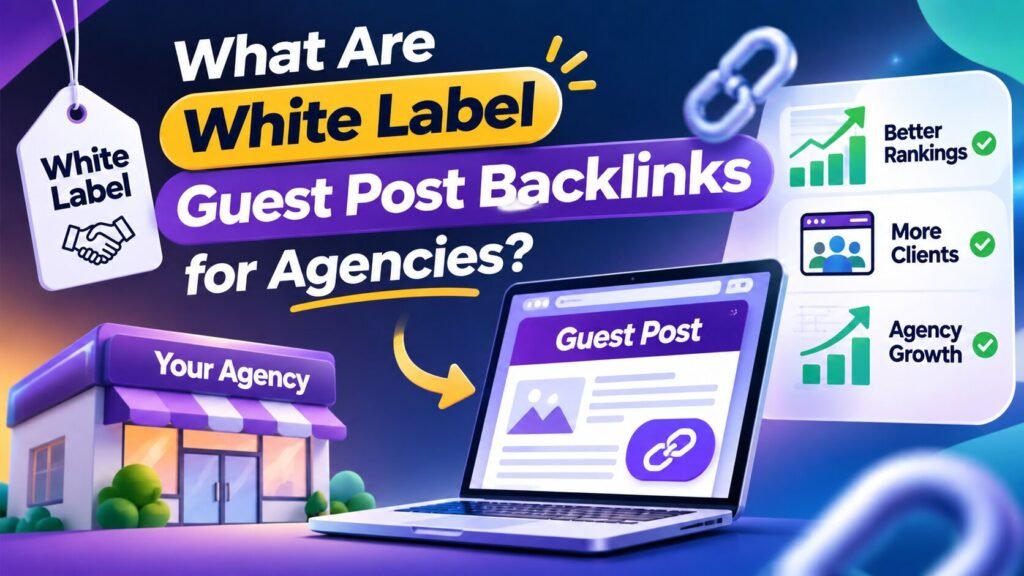
A client wants more links next month. Your team is full, hiring an outreach specialist takes time, and prospecting for one account can swallow days. That’s usually when agencies start looking at white label guest post backlinks for agencies: a supplier does the placement work, and you deliver it under your own name.
The model can work well. It can also put your brand on a weak article, on a site nobody reads, with a link that creates risk for your client. The supplier may be invisible, but your agency still answers for the result.
This guide explains how fulfillment works, what Google’s rules say about paid placements, what published pricing looks like, and how to vet a provider before you send a real client order.
What are white label guest post backlinks for agencies?
They’re links to your client’s website, placed inside articles on third-party sites, that an outside provider arranges and your agency delivers under its own brand.
The provider typically handles publisher research, outreach, writing, publication and reporting. You keep the client relationship, the strategy and the final say on quality. “White label” only describes who gets the visible credit. It tells you nothing about whether the placement is any good.
You’ll see several overlapping terms:
| Term | What it usually means | What to confirm |
|---|---|---|
| White label backlinks | Any links sourced by a supplier and delivered unbranded | Which link types are included |
| Reseller guest posts | Guest post placements bought wholesale and resold | Whether you choose sites or buy by metric tier |
| White label link building service | A broader service that may include guest posts, niche edits or digital PR | Who owns strategy, targets and anchors |
| Agency backlink fulfillment | The production side: sourcing, content, placement and reporting | Turnaround, approvals and replacements |
Providers don’t use these labels consistently, so read the scope of work instead of relying on the product name.
Who this model suits
Outsourcing tends to make sense for:
- SEO agencies with strategy skills but limited outreach capacity.
- Digital marketing agencies adding off-page SEO to existing retainers.
- Consultants who can plan a campaign but can’t run it alone.
- Link building agencies with uneven order volume or gaps in certain niches or languages.
It’s a poor fit if nobody on your side can review a publisher or an article. It’s also a poor fit if the client expects guaranteed rankings, or hasn’t been told how placements are obtained.
How agency backlink fulfillment works
A sound process has clear approval points, so problems get caught before an article goes live.
- Send the brief. Include the client’s website, audience, target pages, markets, excluded sites, restricted topics, budget and any disclosure requirements.
- Agree on the page and link plan. Decide which pages deserve links and why. A useful guide or research page is often easier to reference naturally than a sales page.
- Prospect publishers. The provider finds sites that match the topic and audience. Some pitch each opportunity manually. Others order from an existing publisher list. Ask which you’re buying.
- Approve the sites. Review actual domains, with fees and link attributes, before outreach goes further or content is placed.
- Write and edit. The article should answer a question the publisher’s readers care about. The client link should help that answer.
- Publish and check. Open the live page. Check the destination URL, anchor, surrounding text,
relattribute and whether the page can be indexed. - Report and monitor. Deliver the record under your brand, then recheck links on an agreed schedule.
Manual outreach has an unpredictable side. Editors decline pitches, ask for rewrites, change fees or stop replying. If a provider offers a fixed site, price and date for every order, ask how it arranges that. There may be a legitimate publisher agreement behind it, but you should know what it is.
An example brief
Say your client sells scheduling software to dental practices. A weak order says: “Five DR 50+ dofollow links using ‘dental scheduling software.'”
A stronger brief asks for publications read by practice owners or office managers. It proposes topics such as reducing missed appointments, points to the client’s no-show guide, and lets anchor text follow the sentence. It also lists competitors to avoid and states how any paid link must be labeled.
The second version gives the provider something to judge relevance against. The first mostly gives it a number to hit.
What Google says about paid guest post links
Settle this before you compare prices. Google’s link spam policies cover buying or selling links for ranking purposes, including paying for posts that contain links and exchanging goods or services for them. They also name paid advertorials with links that pass ranking credit, and optimized anchor text in guest posts distributed on other sites.
Google accepts that links can be bought for advertising or sponsorship. Those links need to be qualified with rel="sponsored" or rel="nofollow". Google prefers sponsored for paid placements, and says links with these attributes will generally not be followed.
For agencies, that has practical consequences:
- A paid dofollow guest post isn’t made compliant by good writing, a relevant site or manual outreach.
- A white label invoice doesn’t change how the link was obtained.
- A properly labeled paid placement shouldn’t be sold as a way to pass ranking credit. Judge it on audience fit, brand visibility and referral visits.
- No vendor can truthfully call its placements “Google-approved.”
Rankings can suffer when sites break spam policies, whether Google detects it through automated systems or a manual review. Ask every provider whether money or anything else of value goes to the publisher, and how the link will be marked. Then explain the answer to your client in plain language. For regulated industries or advertising disclosure questions, get qualified legal advice for the markets involved.
Publisher quality matters from another angle too. Google’s site reputation policy addresses third-party content, including content from white-label services, published mainly to benefit from a host site’s established ranking signals. Third-party content alone doesn’t break that policy. Still, be wary when a strong domain has an unrelated, lightly edited section that seems to exist for commercial placements. Enforcement of this particular policy differs inside and outside the European Economic Area.
How to evaluate a guest post site
Start with the site itself. Metrics help you shortlist, but they can’t tell you whether an editor cares about what gets published.
| Check | Good sign | Warning sign |
|---|---|---|
| Site relevance | A clear subject and audience that overlap with the client’s | Casino, health, crypto and home repair posts with no connecting purpose |
| Page relevance | The article and paragraph give the link a reason to exist | A generic article with a client link dropped in |
| Editorial quality | Specific, accurate content with evidence of editing | Thin, repetitive posts and unsupported claims |
| Organic visibility | Estimated traffic from relevant topics and markets | Traffic from unrelated queries, or a sharp unexplained drop |
| Outbound links | References that help readers | Frequent commercial exact-match anchors to unrelated businesses |
| Placement | In the body, beside related information | Author box, footer or a forced sentence |
| Transparency | Sponsored content and link handling are clearly explained | Vague answers about payment and attributes |
| Discoverability | The page is linked within the site and can be indexed | Orphaned page, noindex tag or blocked crawling |
No single warning sign proves a site is bad. Several together are a good reason to reject it.
What DA, DR and traffic can tell you
Domain Authority (Moz) and Domain Rating (Ahrefs) are third-party scores. Ahrefs says plainly that Domain Rating isn’t a Google ranking factor. It measures the strength of a site’s backlink profile compared with other sites in the Ahrefs index.
A high score doesn’t show that the publication reaches your client’s buyers, or that the new page will get any visitors. Google also notes that third-party SEO tools don’t have access to its internal ranking data.
Traffic figures from SEO tools are estimates as well. Look at which pages and countries appear to drive visits, which search terms they rank for, and how the trend has moved over several months. A smaller trade publication with the right readers may be a better choice than a large general site.
Anchor text and target pages
Good anchor text describes the destination and reads normally. Depending on context, that could be the brand name, a page title or a short descriptive phrase.
Avoid fixed anchor ratios presented as universal safety rules. Review the client’s existing links and the sentence in front of you. If the same commercial phrase keeps appearing across guest posts, or the writer has to twist a paragraph to fit it, change the plan. Natural wording doesn’t remove the need to qualify a paid link.
White label guest post pricing
There’s no standard rate. BuzzStream’s link building pricing analysis, updated October 20, 2026, reports an average of $295 for a guest post bought directly from a site and $461 through a vendor. Its guest post tables draw on 257,267 sites.
| Ahrefs DR band | Average direct price (USD) | Average vendor price (USD) |
|---|---|---|
| 0 to 9 | $132 | $196 |
| 30 to 39 | $290 | $458 |
| 50 to 59 | $470 | $759 |
| 70 to 79 | $1,266 | $1,934 |
| 80+ | $1,735 | $2,983 |
Treat these as marketplace benchmarks. They aren’t quotes, wholesale reseller rates or proof of quality. They also don’t establish that a placement meets Google’s policies. Prices vary with industry, traffic, content and the work involved.
The gap between direct and vendor prices isn’t automatically waste. It may cover research, writing, editing and delivery. Ask what’s included so you can see what you’re paying for.
Calculate your real margin
The supplier’s fee is only part of your cost. Here’s a hypothetical example. The $461 uses the vendor average above, while the labor figures are assumptions.
| Cost per placement | Amount (USD) |
|---|---|
| Supplier fee | $461 |
| 1.5 hours of review and account management at $60 per hour | $90 |
| Total delivery cost | $551 |
For a 35% gross margin, you’d charge about $848. For 50%, you’d charge $1,102. The formula is price = delivery cost ÷ (1 − target margin).
Add allowances for revisions, tools, payment fees and replacement work if they apply. A cheap order that takes three rounds of corrections can end up costing more than a pricier one you approve once.
How to choose a white label link building service
Ask these questions before you pay:
- Can we see recent live examples in a relevant niche, with client details protected where needed?
- Do you pitch for each campaign, order from a publisher network, or both?
- Do you own or control any of the sites you offer?
- Can we approve the actual domain before placement?
- Is the publisher paid, and what
relattribute will the link use? - Who writes and fact-checks the article? How is AI used and reviewed?
- Can we approve topics, drafts, target URLs and anchors?
- What does the price include, and what costs extra?
- What happens if the publisher rejects the draft or misses the deadline?
- What happens if the page is deleted, the link changes or
noindexis added? How long does that cover last?
Useful answers are specific. “High-quality sites only” isn’t a quality process. Written rejection criteria are.
Be cautious about promises of rankings or traffic, hidden domains until after payment, and unlimited inventory in every niche. “Permanent link” deserves a follow-up too. A supplier may not control an independent publisher’s future edits, so find out what the promise means in practice: refund, replacement or something else.
Protect your brand in the agreement
White label delivery needs more than removing a logo from a spreadsheet. Put these points in writing:
- Whether the provider may contact your client.
- Which name it uses with publishers. Outreach should never impersonate a client or imply authority it doesn’t have.
- Confidentiality, non-solicitation and portfolio permissions.
- Content ownership, image rights and byline approval. Don’t use invented authors or credentials.
- Data handling and access to shared files.
- Acceptance criteria, revisions, refunds and replacements.
Also check report links, file properties, comments and shared-folder names. Any of them can reveal a supplier by accident.
“White label” can protect a vendor relationship, but it shouldn’t be used to mislead a client about what they’re buying. Don’t claim your internal team did outsourced work if it didn’t.
What a client report should include
For each placement, record the live URL, publication date, target URL, anchor text, link attribute, paid or unpaid status, indexability check and approval notes. If you include DR, DA or traffic estimates, name the tool and the date checked.
Keep delivery separate from performance. A published link confirms the work happened. Referral visits, search performance and conversions need separate measurement, and a ranking change after publication doesn’t prove that one link caused it.
Benefits, risks and common mistakes
| Potential benefit | Trade-off to manage |
|---|---|
| Less time spent prospecting | You still need time for review |
| More capacity without an immediate hire | Quality can slip as order volume grows |
| Access to existing publisher contacts | The same sites may be reused across many clients |
| A repeatable delivery process | Fixed packages can override campaign needs |
| More time for strategy and client service | You depend on a supplier you don’t fully control |
The mistakes that cause trouble are usually basic:
- Buying by DR alone.
- Ordering a large batch before testing the provider.
- Sending every link to a sales page.
- Approving a site without reading its recent posts.
- Promising clients a delivery date that publishers haven’t confirmed.
- Reusing the same publishers across clients without checking fit.
- Sending reports without opening the live pages.
Run a pilot first
Start with a small order that reflects your normal work. Agree on pass and fail criteria in advance: relevance, accuracy, disclosure, communication, turnaround and report quality. Include one revision request if the draft needs it, so you can see how the team responds.
A pilot tests delivery. It’s too small and usually too short to prove SEO impact. Even a good first batch doesn’t remove the need to review later placements.
When outsourcing makes sense, and when it doesn’t
Outsource when outreach time is your bottleneck, demand changes month to month, and you have someone who can approve the work. Keep it in house when you handle few placements, rely on close relationships in a narrow industry, or need tight control over every pitch. A mixed approach also works: your team owns strategy and priority publications while a partner handles defined production tasks.
Guest posts aren’t the only option. Original research, digital PR, expert commentary, partner content and useful free tools can all give other sites a real reason to mention your client. They take effort and don’t guarantee links, but they may suit a client who needs earned editorial coverage more than a set number of paid placements.
Frequently asked questions
Are white label guest post backlinks safe?
White labeling doesn’t make them safe or unsafe. Risk depends on how the link is obtained and marked, along with the content, anchor text and publisher. Paid links intended to pass ranking credit violate Google’s spam policies.
Do sponsored or nofollow guest posts have any value?
They can. A placement may put your client in front of relevant readers and send referral visits. Don’t price or sell it as a link that passes ranking credit, and don’t assume it will bring traffic. Check the publisher’s audience first.
Should clients approve publisher sites before placement?
Your agency should always review them. Client approval is worth adding for regulated, sensitive or brand-conscious accounts. Set a response deadline, because a publisher’s price or availability may change while you wait.
How long does guest post fulfillment take?
It depends on outreach, editor response times, writing, revisions and the publishing queue. Ask for a current estimate at each stage and what happens when it’s missed. Delivery time is also separate from any SEO effect, which can’t be promised on a schedule.
Can a provider guarantee a specific DR or traffic level?
It can set minimum values that a site must meet when you approve it, using a named tool and date. It can’t promise those figures will stay there, and meeting them doesn’t guarantee relevance, rankings or visits to the new article.
What should happen if a link is removed?
Your agreement should say. Define how long monitoring lasts, who checks, how quickly you must report a problem, and whether you get a refund or a comparable replacement. A replacement should pass the same review as the original.
The bottom line
White label fulfillment can take prospecting and production work off your team. It can’t take away your responsibility for what reaches the client. Judge each placement by its audience, content and link handling, and use third-party metrics as supporting information.
Your next step is to write a one-page quality standard with your approval rules, rejection criteria, disclosure requirements and replacement terms. Then test a provider against it with a small order.
If you’re considering outside help with guest posting, blogger outreach or link building, contact backlinksolutions.net with your client niche, target market and requirements. Ask for the same evidence you’d expect from any supplier, and confirm white label terms, publisher fees and link attributes before ordering.