
Digital marketing agencies often face a familiar challenge: clients expect measurable SEO progress, stronger online visibility, and a steady flow of quality backlinks, while agency teams already have a full workload of audits, content, campaigns, reporting, and client communication.
Guest posting can help agencies expand their off-page SEO services without building a large in-house outreach department. A reliable guest post service for digital marketing agencies can support publisher research, outreach, content coordination, placement management, and reporting while allowing the agency to maintain its own client relationships.
The key is choosing a fulfillment approach that prioritizes relevant publishers, editorial quality, transparency, and sustainable processes rather than simply collecting backlinks. In this guide, we’ll explore five practical ways guest posting can benefit digital marketing agencies, how to outsource it effectively, and what to evaluate before working with a fulfillment partner.
1. Expand Your SEO Services Without Hiring an In-House Outreach Team
One of the biggest challenges for digital marketing agencies is managing workloads as their client base grows. SEO campaigns require a combination of technical expertise, content production, keyword research, competitor analysis, and link acquisition. Adding manual publisher outreach to that list can quickly overwhelm an existing team.
Guest posting requires considerable coordination. Someone must identify potential publishers, evaluate their websites, contact editors, negotiate placement terms, prepare content, follow up, and maintain placement records. These tasks can consume hours that your SEO specialists could otherwise spend on campaign strategy and client optimization.
Outsourcing guest post fulfillment can reduce that operational burden.
Instead of building an entire outreach department, agencies can work with an external provider that handles the fulfillment process.
What an outsourced guest post workflow can cover
| Task | Outsourced fulfillment support |
|---|---|
| Publisher research | Finding relevant websites based on niche, audience, and requirements |
| Website evaluation | Reviewing organic visibility, content quality, relevance, and outbound links |
| Outreach | Contacting publishers and managing negotiations |
| Content coordination | Preparing or coordinating articles based on publisher guidelines |
| Placement management | Handling submission, editorial review, and publication follow-up |
| Reporting | Providing published URLs and relevant placement details |
This arrangement can be particularly useful for smaller SEO agencies that have clients requiring link-building campaigns but lack dedicated outreach staff.
When outsourcing makes sense
Outsourcing is worth considering when:
- Your SEO team spends too much time finding and contacting publishers.
- You have clients in several industries and need access to different publisher categories.
- You want to offer link-building services without hiring additional staff.
- You experience fluctuating workloads throughout the month.
- Your agency needs a repeatable fulfillment process.
A reliable fulfillment partner should complement your agency’s existing strategy, not replace your SEO team’s judgment. Your agency should still decide which publishers are appropriate, which content topics are useful, and how off-page SEO fits into each client’s broader marketing plan.
2. Offer More SEO Services and Increase Revenue Opportunities
Many digital marketing agencies already offer SEO audits, on-page optimization, content marketing, technical SEO, and local SEO. Adding guest posting and outreach-based services can help expand that service portfolio.
Clients frequently ask for broader SEO support after an agency has completed the initial optimization work. They may want help with brand visibility, content distribution, digital PR, partnerships, or off-page SEO. Offering these services within the same agency can create additional opportunities to serve existing clients.
Build additional service packages
Guest posting can be incorporated into several agency service models.
| Agency service | How guest posting can support it |
|---|---|
| Monthly SEO retainers | Add ongoing off-page SEO planning and reporting |
| Content marketing | Support content distribution and editorial collaboration |
| SaaS SEO | Target publications relevant to software, business, and technology |
| Local SEO | Explore relevant regional publications and industry websites |
| E-commerce SEO | Identify relevant publications discussing products, shopping, and industry topics |
| Digital PR | Combine editorial outreach with brand-focused content opportunities |
For example, an agency managing SEO for a software company might already handle keyword research, technical optimization, and blog content. The agency could also identify relevant industry publications where useful educational content might be accepted.
Rather than offering a generic backlink package, the agency could develop a broader off-page campaign involving content outreach, industry publications, expert contributions, and brand mentions.
The opportunity is not simply to sell more backlinks. It is to provide a more complete SEO service.
Create flexible pricing models
Agencies can structure their services in different ways, depending on client requirements and the cost of fulfillment.
| Pricing model | How it works |
|---|---|
| Monthly retainer | Client pays a recurring fee for SEO and off-page campaign management |
| Per-placement pricing | Client pays for an agreed placement or publication opportunity |
| Custom campaign | Agency creates a tailored outreach campaign based on niche and goals |
| Content and outreach package | Includes article development, outreach coordination, and reporting |
| Digital PR package | Combines editorial outreach, brand exposure, and content promotion |
Pricing should account for publisher costs, content production, research, project management, revisions, reporting, and any applicable compliance requirements.
Agencies should avoid promising specific ranking improvements simply because backlinks are included in a package. Search performance depends on many factors, and no placement can guarantee a particular ranking or amount of traffic.
3. Access Relevant Publishers Across Multiple Industries
A digital marketing agency may work with clients in healthcare, technology, finance, travel, home improvement, fashion, SaaS, e-commerce, and other sectors.
Finding appropriate publishers in every niche can be difficult. Outreach relationships built for one industry may not be useful for another. A specialized fulfillment partner can potentially help agencies access a broader publisher network and reduce the time required to identify relevant opportunities.
Why topical relevance matters
A backlink from a website should be evaluated in the context of its content, audience, and editorial standards.
For example, an article about cloud software may be more naturally suited to a technology, business, SaaS, or IT publication than a website focused entirely on unrelated topics.
Likewise, a home improvement business may benefit from opportunities on websites discussing renovation, construction, home design, architecture, or property maintenance.
Relevant publishing opportunities should be evaluated using several factors:
- Topical alignment: Does the publication regularly cover subjects related to the client?
- Audience: Would the publication’s readers have a genuine interest in the client’s products, services, or expertise?
- Organic visibility: Does the website appear to have meaningful visibility in relevant search markets?
- Editorial quality: Does it publish useful, original, well-maintained content?
- Outbound link quality: Does the publication link responsibly to relevant sources?
- Publication consistency: Does it maintain a coherent editorial focus?
A practical publisher evaluation table
| Evaluation factor | What to check |
|---|---|
| Domain metrics | Review DR, DA, or other third-party metrics as supporting indicators |
| Organic traffic | Check traffic estimates and historical trends using SEO tools |
| Traffic relevance | Determine whether the audience and search visibility match the client’s market |
| Content quality | Review recent articles, authorship, originality, and editorial standards |
| Niche relevance | Examine the publication’s core topics and the proposed article context |
| Outbound links | Review how frequently and in what context the site links to other businesses |
| Indexing | Check whether recent articles are discoverable in search, without assuming guaranteed indexing |
| Transparency | Confirm pricing, publication terms, editorial policies, and link disclosures |
Third-party metrics such as Domain Rating and Domain Authority can help with initial screening, but they are not Google ranking factors. A high metric alone does not establish that a publication is valuable or appropriate.
Avoid relying on metrics alone
A website may have a strong DR or DA but still be a poor choice because its audience is irrelevant, its editorial quality is inconsistent, or its outbound link patterns suggest excessive commercial publishing.
For agencies, publisher selection should be based on a combination of relevance, content quality, visibility, audience, and editorial considerations rather than a single number.
4. Scale Client Campaigns With White-Label Guest Posting
White-label guest posting allows agencies to outsource fulfillment while maintaining their own client-facing brand and relationship.
This model can be useful when an agency wants to offer guest blogging for agencies as part of its SEO services but does not want to manage every publisher interaction internally.
In a typical white-label arrangement, the agency manages the client, campaign strategy, pricing, and communication, while the fulfillment provider handles agreed operational tasks.
How a white-label arrangement works
Step 1: The agency receives a client order
The agency collects the client’s niche, target URLs, content requirements, campaign goals, budget, and preferences.
Step 2: Publisher research and selection
The fulfillment partner identifies potential publishers based on agreed criteria and shares suitable opportunities where required.
Step 3: Content preparation
The article is prepared according to the publication’s editorial guidelines, subject matter, and content requirements.
Step 4: Outreach and submission
The provider coordinates submission, communication, and editorial review with the publisher.
Step 5: Publication and reporting
Once publication is completed, the agency receives the live URL and relevant placement details to share with its client.
What agencies can manage themselves
In a well-organized white-label model, your agency can retain control of:
- Client communication
- Campaign strategy
- Target URLs
- Anchor text planning
- Publisher selection and approval
- Client pricing
- Reporting format
- Overall SEO recommendations
The fulfillment provider can handle:
- Publisher prospecting
- Outreach
- Negotiation and coordination
- Content preparation or coordination
- Submission and follow-up
- Publication tracking
The exact division of work should be agreed upon before starting.
Why this model can help agencies
White-label fulfillment can make it easier to:
- Expand service capacity without hiring a large team.
- Handle client orders during busy periods.
- Offer services across several industries.
- Keep client-facing communication consistent.
- Focus internal resources on strategy and campaign management.
For agencies exploring external fulfillment, white-label link building is one example of how providers structure outsourced link-building workflows. The service model, pricing, minimum requirements, and terms vary by provider, so agencies should compare them carefully.
5. Save Time on Outreach, Reporting, and Campaign Management
Outreach is rarely a single task. It involves research, email communication, follow-ups, publisher negotiations, article preparation, approval, publication tracking, and reporting.
When an agency handles several clients simultaneously, these activities can become difficult to manage consistently.
A structured guest posting workflow can help reduce administrative work and make campaign management more predictable.
Organize outreach into a repeatable process
Agencies can improve their workflow by separating the process into clear stages.
| Stage | Recommended process |
|---|---|
| Client intake | Collect niche, campaign goals, target pages, budget, and requirements |
| Publisher research | Identify potential websites and assess their suitability |
| Approval | Share publisher options or selection criteria with clients |
| Content development | Prepare original articles aligned with the publication |
| Outreach | Submit articles and manage publisher communication |
| Follow-up | Track editorial feedback and publication progress |
| Quality review | Verify the live article, links, content, and publication details |
| Reporting | Record the live URL, publisher details, date, and agreed deliverables |
Use a centralized tracking sheet
A shared spreadsheet or project management tool can help agencies monitor every placement without relying on scattered email conversations.
Useful tracking fields include:
- Client name
- Client website
- Target URL
- Anchor text
- Publisher website
- Publisher niche
- Placement type
- Agreed price
- Content submission date
- Publication date
- Status
- Live URL
- Notes
A simple status system can make the process easier to manage:
- Published: Placement completed and verified.
- In Progress: Outreach, submission, or editorial review is ongoing.
- Pending: Waiting for approval, payment, content, or publisher response.
- Cancelled: Placement is no longer proceeding.
This approach helps prevent duplicate outreach, missed follow-ups, incomplete reporting, and confusion between client orders.
Make reporting easier for clients
A good placement report should provide more than a list of URLs. Agencies should include enough information to help clients understand what was delivered.
A basic report may include:
| Report field | Purpose |
|---|---|
| Live URL | Verify the published article |
| Publisher | Identify the website |
| Publication date | Record when the placement went live |
| Target URL | Show the client’s destination page |
| Anchor text | Document the link text |
| Article topic | Explain the content context |
| Placement type | Clarify whether it was a guest article or another editorial opportunity |
| Notes | Include relevant editorial or link details |
This makes reporting more transparent and helps the agency maintain a professional relationship with its clients.
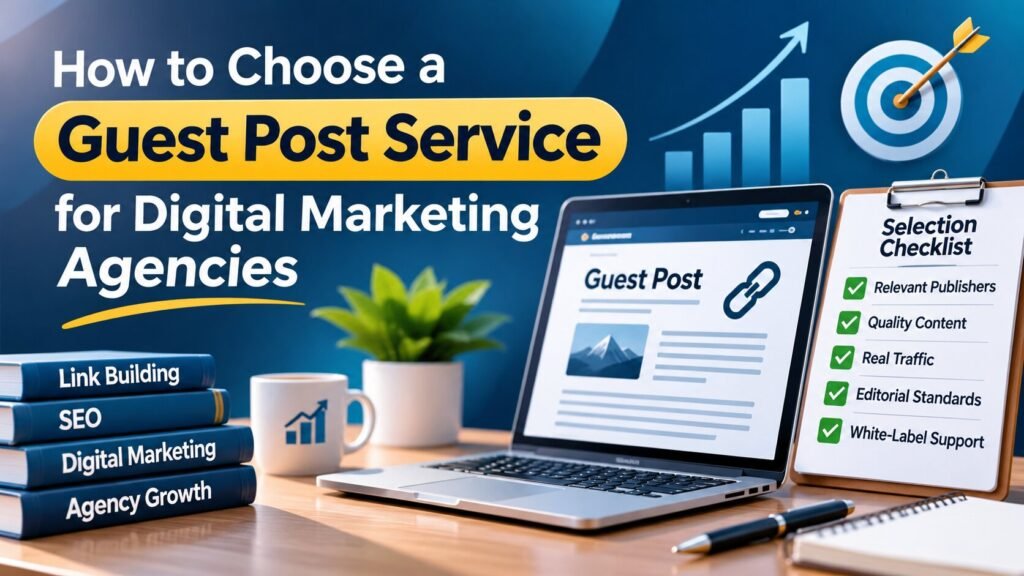
How to Choose a Guest Post Service for Digital Marketing Agencies
Choosing the right fulfillment provider can affect the quality of your campaigns, client satisfaction, profitability, and internal workload.
Not every provider operates in the same way. Some focus on publisher outreach, others offer complete fulfillment, and some specialize in particular industries.
Before partnering with a provider, evaluate the following factors.
1. Publisher quality and relevance
Ask how websites are selected and whether you can review publishers before placement.
A good provider should be able to explain its selection process instead of relying exclusively on DR, DA, or other third-party metrics.
2. Transparent pricing
Understand what each placement includes.
Ask whether the quoted price covers:
- Publisher fees
- Content writing
- Outreach
- Editorial revisions
- Publication
- Reporting
- Additional links
- Any extra charges
Clear pricing helps agencies calculate margins and avoid unexpected costs.
3. Content quality
Content should be useful to the publication’s readers, relevant to the subject, and written according to the publisher’s guidelines.
Ask about word counts, revisions, editorial approval, content ownership, and whether the provider uses writers familiar with the client’s industry.
4. Communication and turnaround time
Ask how long publisher research, article preparation, outreach, and publication typically take.
Turnaround time varies by publisher, niche, editorial review, content requirements, and availability. Treat estimated timelines as estimates rather than guarantees.
5. Reporting and verification
Make sure you receive the live URL and enough information to verify the placement.
Check whether the article is accessible, whether the content matches the approved topic, whether the links work, and whether the agreed link attributes and disclosure arrangements are accurately reported.
6. Flexible fulfillment
Your agency may need different publisher types, budgets, niches, and content requirements.
A provider with flexible fulfillment options may be easier to work with than one offering only a rigid package.
7. Honest SEO practices
A provider should not promise guaranteed rankings, guaranteed traffic, or guaranteed indexing.
It should also explain the nature of paid placements and editorial disclosures where relevant.
Guest Posting, SEO Guidelines, and Link Quality
Guest posting can be used for content collaboration, audience exposure, industry expertise, brand awareness, and editorial outreach. However, agencies should understand the distinction between genuine editorial contributions and link placements intended primarily to manipulate search rankings.
Google’s link spam policies identify paid links that pass ranking credit, including certain paid guest posts and advertorial links, as potential link spam.
Google also explains that paid links can be acceptable for advertising and sponsorship purposes when they are appropriately qualified with rel="sponsored" or rel="nofollow".
This distinction matters when agencies purchase or outsource editorial placements.
What agencies should consider
- Editorial relevance: Articles should make sense for the publication and its readers.
- Originality: Avoid copied, spun, or low-value content.
- Transparency: Understand whether a placement is paid and whether disclosures are required.
- Link qualification: Review whether links should be marked as sponsored or nofollow based on the nature of the arrangement.
- Natural content: Avoid content written solely to insert commercial anchor text.
- Audience value: Consider whether the article would be useful even if search engines did not provide ranking benefits.
Agencies should not present paid, unqualified links as guaranteed ranking improvements or as Google-approved SEO tactics. Compliance, editorial standards, and long-term reputation should remain part of campaign planning.
Common Mistakes Agencies Should Avoid
Outsourcing digital marketing guest posts can make campaign management easier, but poor vendor selection or weak processes can create unnecessary problems.
Choosing publishers based only on DR or DA
A high domain metric does not automatically make a website a good publisher. Agencies should also evaluate content quality, relevance, audience, organic visibility, and outbound link patterns.
Ordering placements without reviewing the websites
Avoid accepting every publisher offered by a vendor. Review websites before placing client content, especially when the campaign involves sensitive industries or strict brand requirements.
Using overly optimized anchor text
Repeatedly using exact-match commercial keywords in backlinks can create an unnatural link profile. Anchor text should fit the context of the article, and agencies should not promise that a particular anchor strategy will improve rankings.
Ignoring editorial disclosure requirements
Some publishers require paid-content disclosures or qualified links. Agencies should understand these terms before accepting a placement and communicate them clearly to clients.
Promising guaranteed SEO results
Guest posting does not guarantee higher rankings, increased traffic, or indexing. SEO results depend on multiple factors, including website quality, competition, content, technical performance, and search engine evaluation.
Working with unclear fulfillment terms
Before ordering, confirm pricing, publication requirements, link attributes, content revisions, replacement policies, cancellation terms, and expected turnaround time.
How BacklinkSolutions.net Can Support Digital Marketing Agencies
Agencies that want to expand their off-page SEO services without handling every outreach task internally can explore outsourced guest post fulfillment.
At BacklinkSolutions.net, agencies can explore guest post and blogger outreach opportunities designed to support different niches, campaign requirements, and client needs.
Outsourcing can help agencies reduce manual publisher prospecting, coordinate content placement, and manage fulfillment while keeping control of their client relationships and SEO strategies.
Depending on the campaign, agencies may explore:
- Guest post placement opportunities
- Blogger outreach
- Niche-specific publisher research
- Link insertion opportunities
- White-label fulfillment arrangements
- Off-page SEO support
Publisher availability, placement requirements, pricing, and fulfillment timelines depend on the individual campaign and website.
The goal is to help agencies manage the operational side of outreach more efficiently while focusing on strategy, client service, and broader SEO objectives.
FAQs
What is a guest post service for digital marketing agencies?
A guest post service for digital marketing agencies helps agencies outsource tasks such as publisher research, outreach, article coordination, submission, and publication management. Depending on the provider, it may also offer white-label fulfillment so the agency can manage the client relationship independently.
Why do digital marketing agencies outsource guest posting?
Agencies often outsource guest posting to reduce manual outreach work, expand publisher access, manage workloads, and offer off-page SEO services without hiring a dedicated outreach team.
What is white-label guest posting?
White-label guest posting is a fulfillment arrangement in which an agency outsources guest post work to another provider while maintaining its own client-facing brand, communication, and pricing structure. The exact arrangement depends on the provider’s terms.
How should agencies evaluate guest post websites?
Agencies should consider topical relevance, audience, organic visibility, editorial quality, content originality, outbound link patterns, and publication transparency. DR and DA can be useful supporting metrics, but they should not be the sole selection criteria.
Are guest post backlinks guaranteed to improve rankings?
No. Backlinks do not guarantee rankings, traffic, or indexing. Google evaluates many factors, and paid links intended to manipulate rankings may violate its link spam policies. Agencies should focus on useful content, appropriate editorial practices, and transparent link arrangements.
Can small agencies use guest posting services?
Yes. Small agencies can outsource guest post fulfillment to reduce the time spent on outreach and publisher coordination. The service should fit their budgets, client requirements, and operational needs.
What should agencies include in guest post reports?
Reports should include the publisher website, live URL, publication date, article topic, target URL, anchor text, placement type, and relevant notes about link attributes or editorial disclosures.
Conclusion
Guest posting can help digital marketing agencies expand their services, manage outreach workloads, access relevant publishers, and create more flexible SEO fulfillment processes.
The biggest benefits come from having a structured approach. Agencies should evaluate publishers carefully, prioritize content relevance, maintain transparent reporting, and understand the search engine guidelines surrounding paid links.
A reliable fulfillment partner can support the operational side of guest posting, allowing agency teams to spend more time on strategy, content planning, client communication, and campaign management.
If your agency is looking to expand its off-page SEO services, explore the guest post and outreach solutions available at BacklinkSolutions.net to see whether outsourced fulfillment fits your workflow.