
Running an ecommerce website means competing for visibility in search results where established retailers, niche stores, manufacturers, and marketplaces are already fighting for attention. Publishing useful product pages and optimizing category pages are important, but an online store also needs a strong reputation across the wider web.
This is where a guest post service for ecommerce websites can help. It gives ecommerce brands and SEO agencies access to relevant blogs and publishers where they can contribute useful content, build industry relationships, and earn brand exposure through editorial placements.
For agencies managing several online stores, handling publisher research, outreach, content creation, and placement tracking internally can become time-consuming. Outsourcing this work offers another way to manage campaign fulfillment without building a large outreach team.
In this guide, we explain how ecommerce guest posting works, what makes a publisher worth targeting, how to evaluate backlink quality, what agencies should expect from a provider, and how to avoid common link-building mistakes.
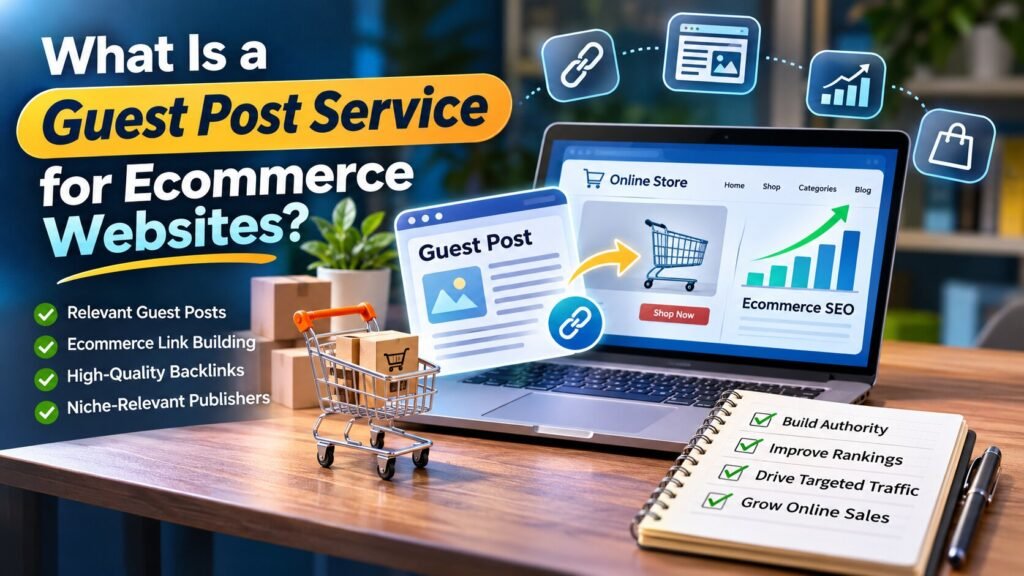
What Is a Guest Post Service for Ecommerce Websites?
A guest post service for ecommerce websites is a link-building and content outreach service that helps online stores publish relevant articles on third-party websites.
The service typically involves identifying suitable publishers, contacting website owners or editors, preparing original articles, coordinating publication, and reporting the resulting placements.
For example, imagine an online store selling sustainable home products. Instead of publishing every article on its own blog, the store could contribute useful content to home improvement, interior design, sustainability, and lifestyle publications.
Possible article topics include:
- How to Choose Environmentally Friendly Cleaning Products
- Practical Ways to Create a More Sustainable Home
- What to Consider Before Buying Energy-Efficient Appliances
- Simple Changes That Reduce Household Waste
These articles can introduce the brand to readers who already have an interest in its products and industry.
An ecommerce guest post campaign is not simply about placing a link on as many websites as possible. Publisher relevance, editorial standards, audience quality, and the usefulness of the article all matter.
Why Do Ecommerce Websites Need Guest Posting?
Ecommerce businesses often face a different link-building challenge from service-based businesses. A local consultant might naturally receive links from business directories, professional associations, and industry publications. An online store, however, may have hundreds of product and category pages that rarely attract editorial references.
Guest posting provides an opportunity to reach relevant audiences outside the store’s existing customer base.
1. Build industry relevance
A backlink from a website covering the same industry can provide useful context about a brand and its products.
For example:
| Ecommerce niche | Relevant guest post publishers |
|---|---|
| Fashion and clothing | Fashion blogs, lifestyle magazines, beauty publications |
| Home and furniture | Interior design, DIY, home improvement blogs |
| Electronics | Technology blogs, gadget publications, consumer advice websites |
| Health and beauty products | Beauty, skincare, wellness publications |
| Pet supplies | Pet care blogs, animal welfare publications |
| Sports equipment | Fitness, outdoor activities, sports publications |
| Food and beverages | Food blogs, cooking publications, nutrition websites |
A relevant publisher is generally a better prospect than a website selected simply because it has a high Domain Rating.
2. Increase brand exposure
A well-written guest article can introduce an ecommerce business to readers who have never encountered the brand.
For instance, a company selling premium running shoes could contribute an article about choosing running footwear for different training needs.
Readers interested in the subject may discover the brand through the article, even if they do not click the backlink immediately.
This makes guest contributions useful for brand awareness as well as referral opportunities.
3. Support ecommerce SEO strategies
External links are one part of a broader SEO strategy. Relevant editorial coverage can help search engines discover relationships between websites and pages.
However, a backlink does not guarantee better rankings, increased organic traffic, or sales. Results depend on many factors, including the quality of the linking page, the destination page, competition, technical SEO, and the overall website.
4. Reach audiences in different markets
An ecommerce store selling internationally may want visibility in several countries.
For example, a UK-based fashion store expanding into the US market might seek editorial coverage from American fashion and lifestyle publishers.
Likewise, an online electronics retailer could target technology publications in the UK, Canada, Australia, and other relevant markets.
The important consideration is audience fit. A website’s country should support the campaign’s objectives rather than simply satisfy a geographic target.
How Does an Ecommerce Guest Post Service Work?
A professional service should follow a structured process rather than sending generic articles to random websites.
Here is how a typical campaign can work.
Step 1: Understand the ecommerce business
The first step is understanding what the online store sells, who its customers are, and which markets it serves.
A provider should collect information about:
- Website URL and business name
- Product categories
- Target audience
- Target countries
- Preferred landing pages
- Relevant keywords and topics
- Competitors
- Campaign objectives
This information helps determine which publishers and article topics are appropriate.
For example, a business selling organic skincare products should prioritize beauty, skincare, wellness, and lifestyle publications instead of unrelated general blogs.
Step 2: Research relevant websites
Publisher research is one of the most important parts of ecommerce link building.
An outreach provider should evaluate potential websites before contacting their owners or editors.
Useful research tools include Ahrefs, SEMrush, and other SEO analysis platforms. These tools can help assess backlink profiles, estimated organic traffic, ranking keywords, and referring domains.
However, tool metrics should be treated as research indicators rather than proof of website quality.
Step 3: Contact website owners and editors
Once suitable publishers have been identified, the outreach process begins.
A professional outreach message should explain:
- Who is contacting the publisher
- What subject the proposed article covers
- Why the topic suits the publication
- What value the article offers its readers
- Whether the contribution is sponsored or otherwise commercially arranged
Personalized communication is generally more useful than sending identical emails to hundreds of unrelated websites.
Step 4: Prepare original content
After a publisher agrees to consider a contribution, the article needs to meet its editorial requirements.
A good ecommerce guest post should:
- Address a relevant subject.
- Provide practical information.
- Use natural language.
- Include accurate information.
- Avoid unnecessary promotional statements.
- Reference the ecommerce brand only where relevant.
- Use links appropriately.
For example, an article about selecting durable kitchen equipment could naturally discuss materials, maintenance, and product features before referencing a relevant online store.
The article should be valuable even if the reader never clicks the link.
Step 5: Coordinate publication
After content approval, the publisher schedules and publishes the article.
The provider should check the live placement to confirm:
- The article is publicly accessible.
- The correct target URL is included.
- The anchor text is accurate.
- The article has not been substantially changed.
- The link attributes are correctly reported.
- The page is indexable where indexing is expected.
A published article is not necessarily indexed by Google, so indexing should not be promised without verification.
Step 6: Deliver a placement report
Agencies and ecommerce clients need clear reporting.
A useful report should include:
| Reporting detail | Why it matters |
|---|---|
| Publisher URL | Allows the client to inspect the placement |
| Website name | Identifies the publisher |
| Target URL | Confirms the linked ecommerce page |
| Anchor text | Shows how the destination is referenced |
| DR/DA | Provides third-party backlink comparisons |
| Estimated organic traffic | Helps assess potential search visibility |
| Publication date | Records when the article went live |
| Link attribute | Identifies whether the link is sponsored, nofollow, or otherwise qualified |
| Placement status | Shows whether the article is live and accessible |
A report should distinguish between verified facts and third-party estimates.
What Makes a Good Ecommerce Guest Post Backlink?
Not every backlink has the same potential value. A website can have impressive SEO metrics but still be a poor choice for a particular ecommerce campaign.
Before approving a placement, evaluate the following factors.
1. Topical relevance
Relevance should be one of the first considerations.
Suppose an online store sells camping equipment. A placement on an outdoor adventure blog is more contextually appropriate than one on a website primarily covering unrelated financial topics.
Look beyond the website’s homepage description. Check its actual articles, categories, authors, and recent publication history.
2. Organic search visibility
Check whether the publisher receives organic search traffic.
Ahrefs and SEMrush provide estimated organic traffic data that can help identify websites with search visibility.
Look at:
- Traffic trends over time.
- Ranking keywords.
- Countries generating traffic.
- Top-performing pages.
- Relevant keyword rankings.
A website with declining visibility or large numbers of unrelated ranking keywords deserves closer investigation.
Remember that third-party traffic figures are estimates, not verified visitor counts.
3. Website and content quality
Read several recent articles before approving a publisher.
Check whether the content is:
- Original and informative.
- Properly structured.
- Written for a recognizable audience.
- Edited professionally.
- Relevant to the website’s subject.
- Published consistently.
If every article appears to be created mainly to sell backlinks, the website may not be a suitable editorial environment.
4. Domain Rating and Domain Authority
Domain Rating (DR) and Domain Authority (DA) are commonly used during backlink prospecting.
They can help compare websites, but neither metric should determine placement quality on its own.
For example, consider these two hypothetical publishers:
| Evaluation factor | Website A | Website B |
|---|---|---|
| DR | 75 | 42 |
| Monthly estimated traffic | 500 | 18,000 |
| Industry relevance | Low | High |
| Content quality | Average | Strong |
| Audience fit | Poor | Good |
Website B may be the more appropriate prospect despite its lower DR.
Ahrefs explains the limitations of Domain Rating in its SEO metrics guide. The metric measures backlink profile strength, not overall editorial quality or legitimacy.
5. Outbound link patterns
Examine the other websites the publisher links to.
Warning signs include:
- Excessive commercial anchor text.
- Large numbers of unrelated outbound links.
- Repeated links to suspicious websites.
- Articles that appear to exist primarily for link placements.
- Unnatural links inserted into irrelevant paragraphs.
A publisher should maintain reasonable editorial standards for both incoming and outgoing content.
6. Page-level quality
A website’s overall metrics do not automatically make every article valuable.
Consider the actual page where the guest article will appear.
Check its:
- Topic relevance.
- Content depth.
- Internal links.
- Publication visibility.
- Indexability.
- Relationship with the publisher’s main website.
A relevant, useful article on a well-maintained website is a better prospect than an unrelated page selected solely for its domain score.
Which Ecommerce Pages Should Receive Backlinks?
One common mistake is directing every backlink to an ecommerce homepage.
Different pages serve different purposes, and the destination should match the article’s context.
| Destination page | Suitable article context |
|---|---|
| Homepage | Brand introductions and company-related topics |
| Product category page | Buying guides and product comparisons |
| Individual product page | Specific product features and recommendations |
| Ecommerce blog | Educational content and industry resources |
| Buying guide | Research-based articles and practical advice |
| Brand story page | Business background and company expertise |
Example: An online furniture store
Imagine a business selling office furniture.
It has several important pages:
- Homepage
- Office chairs category
- Standing desks category
- Ergonomic furniture buying guide
- Individual adjustable desk product page
Rather than linking every article to the homepage, the outreach campaign can identify appropriate destinations.
An article about workplace ergonomics might reference the buying guide. A contribution about choosing an office chair could link to the relevant category.
This approach creates a more logical relationship between the article and the destination.
However, links should never be forced into an article simply to target a commercial page. The destination must genuinely help the reader.
How to Choose the Right Anchor Text for Ecommerce Backlinks
Anchor text is the clickable wording used in a hyperlink.
For ecommerce websites, anchor selection requires particular care because product and category keywords can be highly commercial.
Common anchor text types include:
| Anchor type | Example |
|---|---|
| Branded | Example Store |
| Naked URL | example.com |
| Generic | Visit the website |
| Partial match | ergonomic office chairs |
| Descriptive | guide to choosing office furniture |
| Product-related | adjustable standing desk |
A sensible campaign should avoid repeating the same keyword-rich anchor across every placement.
Instead, anchor text should fit the sentence and accurately describe the destination.
For example, an article discussing home office improvements could naturally reference an ergonomic furniture buying guide.
There is no universal ideal percentage for branded, exact-match, or partial-match anchors. Anchor selection should reflect the editorial context rather than an artificial ratio.
Most importantly, do not treat anchor text as a way to force rankings.
What Are the Risks of Ecommerce Guest Posting?
Guest posting can support legitimate content distribution and audience development, but using it primarily to manipulate search rankings creates risks.
Google’s link spam policies specifically address paid links that pass ranking credit, excessive link exchanges, automated link creation, and keyword-rich links in guest posts.
Google also explains that paid placements should be qualified with appropriate link attributes.
Paid guest posts and sponsored links
This distinction is particularly important for agencies purchasing placements.
If a publisher receives payment for an article or link, Google recommends marking the link with rel="sponsored". The rel="nofollow" attribute is also an acceptable option.
Google provides detailed instructions in its outbound link qualification documentation.
A service provider should be transparent about whether a placement is sponsored, whether the publisher controls its editorial decisions, and which link attributes will be used.
A paid placement should not be sold as a guaranteed ranking credit.
Low-quality publisher networks
Some providers focus on selling large numbers of placements without meaningful publisher evaluation.
Potential warning signs include:
- Websites covering dozens of unrelated industries.
- Repeated articles with identical structures.
- Unnatural outbound link patterns.
- Little evidence of a genuine readership.
- Inflated SEO metrics.
- Poor-quality or copied content.
Over-optimized anchor text
Using commercial keywords repeatedly in backlinks can create unnatural patterns.
Instead of forcing exact-match anchors into every article, prioritize natural descriptions that make sense to readers.
Thin or promotional content
A guest article should not read like a product advertisement disguised as an educational resource.
Content that provides no meaningful information is unlikely to offer a good reader experience.
No quality control after publication
Some providers deliver a spreadsheet and consider the job complete.
However, publishers can change URLs, remove articles, modify links, or update content after publication.
Agencies should establish what post-publication checks and reporting are included in the service agreement.
Guest Post Service vs. Other Ecommerce Link-Building Methods
Guest posting is one option within a broader ecommerce link-building strategy. It should not be treated as the only way to acquire relevant backlinks.
Here is how it compares with other common approaches.
| Strategy | Main purpose | Best suited for |
|---|---|---|
| Guest posting | Publish useful contributions on relevant websites | Brands seeking industry exposure |
| Digital PR | Earn editorial coverage through newsworthy stories | Established brands and research-led campaigns |
| Niche edits | Obtain contextual mentions in existing articles | Relevant resource-based outreach |
| Broken link building | Suggest useful replacements for broken references | Websites with relevant resources |
| Supplier backlinks | Obtain mentions from manufacturers and partners | Retailers with supplier relationships |
| Product reviews | Introduce products through independent reviewers | Product-led ecommerce brands |
| Resource page outreach | Earn mentions on useful industry resource pages | Brands with valuable guides and tools |
For example, an ecommerce store selling fitness equipment could combine guest contributions to fitness blogs with product reviews, supplier relationships, and digital PR.
This creates a more varied approach than relying exclusively on guest post placements.
How Much Does an Ecommerce Guest Post Service Cost?
The cost depends on the publisher, content requirements, outreach process, location, and level of quality control.
There is no universal price for an ecommerce guest post.
Some providers charge per placement, while others offer monthly fulfillment packages or customized campaigns.
Factors that influence pricing
1. Publisher quality
Websites with strong editorial standards, relevant audiences, and established organic visibility may require more outreach effort or higher placement fees.
2. Content requirements
A detailed article requiring research, expert input, or specialist writing will generally involve more work than a basic contribution.
3. Industry competitiveness
Some niches have more publishers willing to accept relevant contributions. Others require extensive prospecting and relationship-building.
4. Target country
Publisher availability and commercial expectations vary between the USA, UK, Canada, Australia, and other markets.
5. Outreach and fulfillment
A complete service may include prospect research, personalized outreach, writing, editing, publication coordination, and reporting.
What should agencies compare?
Rather than selecting a provider based on the lowest price, agencies should compare the complete fulfillment process.
Ask providers:
- Are publishers checked before approval?
- Is organic traffic reviewed?
- Can I approve websites before publication?
- Is content included?
- Are placements relevant to the client’s niche?
- Are sponsored link attributes disclosed?
- Are live URLs provided?
- What happens if an article is removed?
- Are there additional publication or writing charges?
A transparent quote should explain exactly what is included.
When Should SEO Agencies Outsource Ecommerce Guest Posting?
Managing outreach internally can make sense when an agency has an experienced team, established publisher relationships, and enough time to handle prospecting and content production.
However, outsourcing becomes worth considering when fulfillment starts affecting other agency responsibilities.
1. When managing multiple ecommerce clients
An agency handling SEO for several online stores may need placements across fashion, technology, beauty, home improvement, and other industries.
Building publisher lists and coordinating individual campaigns for every client can consume considerable time.
A fulfillment partner can handle parts of this process while the agency retains responsibility for strategy and client communication.
2. When internal outreach resources are limited
Successful outreach requires more than sending emails.
It involves:
- Publisher research.
- Contact discovery.
- Email personalization.
- Follow-ups.
- Editorial communication.
- Content preparation.
- Publication tracking.
Agencies without dedicated outreach staff may find it more practical to outsource these activities.
3. When expanding into new markets
An agency working with a US ecommerce brand might receive a new client targeting the UK or Australia.
Instead of developing an entirely new publisher database, it can work with a provider that already handles outreach across different markets.
Publisher quality should still be evaluated individually.
4. When offering white-label fulfillment
White-label link building allows agencies to outsource campaign fulfillment while presenting the service under their own brand.
This can help agencies expand their service offering without building every operational process internally.
However, white-label arrangements should not mean hiding important placement information or misrepresenting how links are acquired.
How to Choose a White-Label Ecommerce Guest Post Provider
Choosing the right fulfillment partner can affect campaign quality, client satisfaction, and your agency’s reputation.
Before working with a provider, evaluate these areas.
Publisher database and niche coverage
Ask whether the provider can source websites related to your clients’ industries.
A useful provider should understand the difference between a relevant publisher and a website that simply accepts articles from everyone.
Outreach process
Find out whether the provider contacts publishers individually or relies on an established list of paid placement opportunities.
Neither arrangement should be misrepresented. Agencies need to understand what they are purchasing.
Reporting transparency
Request sample placement reports.
You should be able to inspect the actual article, target URL, anchor text, publication date, and link attributes.
Content quality
Ask whether content is original and whether it undergoes editorial review.
A placement should not require your team to rewrite every article before it is ready for a client.
Communication and order management
For ongoing campaigns, response times and clear order updates matter.
A provider should communicate delays, publisher rejections, content changes, and publication issues rather than leaving the agency to chase every order.
Scalability
If your agency manages five ecommerce clients today and twenty next year, your fulfillment process needs to accommodate additional work without sacrificing quality.
Ask about available niches, geographic coverage, content capacity, and realistic turnaround times.
Why Consider BacklinkSolutions for Ecommerce Guest Post Fulfillment?
Agencies that want to expand their link-building services do not always need to manage every outreach activity internally.
BacklinkSolutions provides guest posting, blogger outreach, and link-building services for businesses and agencies working across different industries.
For ecommerce campaigns, the service can be considered when an agency needs support with relevant publisher research, guest post placements, and campaign fulfillment.
The approach should begin with understanding the client’s niche, target pages, preferred countries, and publisher requirements.
This is particularly useful for agencies managing multiple ecommerce projects that require different types of publisher coverage.
Potential advantages of outsourcing include:
- Less time spent on individual publisher prospecting.
- Reduced internal outreach workload.
- Support across different industries and niches.
- A more manageable fulfillment process.
- More time for client strategy and reporting.
- White-label service opportunities for agencies.
The right placement still depends on publisher relevance, editorial quality, and campaign requirements. Agencies should review placement details before presenting completed work to their clients.
If you are looking for a fulfillment partner, visit BacklinkSolutions to discuss your guest posting requirements.
Frequently Asked Questions
1. What is a guest post service for ecommerce websites?
It is a service that helps ecommerce businesses publish relevant articles on external websites. The process can include publisher research, blogger outreach, content creation, editorial coordination, and placement reporting.
2. Are ecommerce guest posts good for SEO?
Relevant editorial contributions can help brands reach new audiences and earn useful references. However, paid links intended to manipulate search rankings violate Google’s link spam policies unless appropriately qualified. No guest post guarantees improved rankings.
3. How do I find relevant websites for ecommerce guest posting?
Start by identifying blogs, magazines, and publications covering the same industry as your store. Use tools such as Ahrefs and SEMrush to investigate organic visibility, backlinks, and ranking keywords. Then manually review content quality and audience relevance.
4. Should ecommerce backlinks point to product pages or the homepage?
It depends on the article’s subject. Brand introductions may naturally reference the homepage, while buying guides and product-specific articles may reference relevant category pages, guides, or individual products. The link should always make sense in context.
5. What is the difference between guest posting and niche edits?
Guest posting involves publishing a new article on another website. Niche edits involve obtaining a contextual link within an existing article or resource. Both approaches require careful publisher evaluation and appropriate handling of paid links.
6. Can SEO agencies outsource ecommerce guest posting under their own brand?
Yes. White-label fulfillment allows agencies to outsource prospecting, content, and placement coordination while managing client relationships under their own brand. Agencies should maintain transparency about the work delivered and avoid misleading clients about publisher arrangements.
7. How many guest posts does an ecommerce website need?
There is no fixed number. The appropriate campaign size depends on the website’s existing backlink profile, competition, available budget, content strategy, and business objectives. A smaller number of carefully selected editorial opportunities may be more useful than a large quantity of unrelated placements.
Conclusion
A guest post service for ecommerce websites can help online stores and SEO agencies manage publisher outreach, content production, and external publication opportunities.
However, the value of a campaign should not be measured by the number of backlinks or the highest available DR score. Publisher relevance, useful content, genuine audience fit, transparent reporting, and appropriate link attributes deserve more attention.
For SEO agencies managing multiple ecommerce clients, outsourcing can also reduce the operational workload involved in prospecting and placement fulfillment.
If you need support with ecommerce guest posts or white-label link-building fulfillment, visit BacklinkSolutions to discuss your campaign requirements.