
If you run an SEO agency, you have probably had this month: three clients need links, your outreach person is buried, and the publisher list you built last year is full of sites that stopped replying. You could hire another prospector, or you could hand the work to someone who does it all day. That is the situation where a contextual dofollow guest post service comes in.
This guide explains what the service actually is, how it works behind the scenes, and what separates a useful placement from a link that does nothing. It also covers the part many vendors skip: where dofollow guest posting sits against Google’s spam policies. By the end you should be able to judge a provider without leaning on a DR number or a price list.
What a contextual dofollow guest post service actually is
The name is three ideas stacked together, so it helps to take them one at a time.
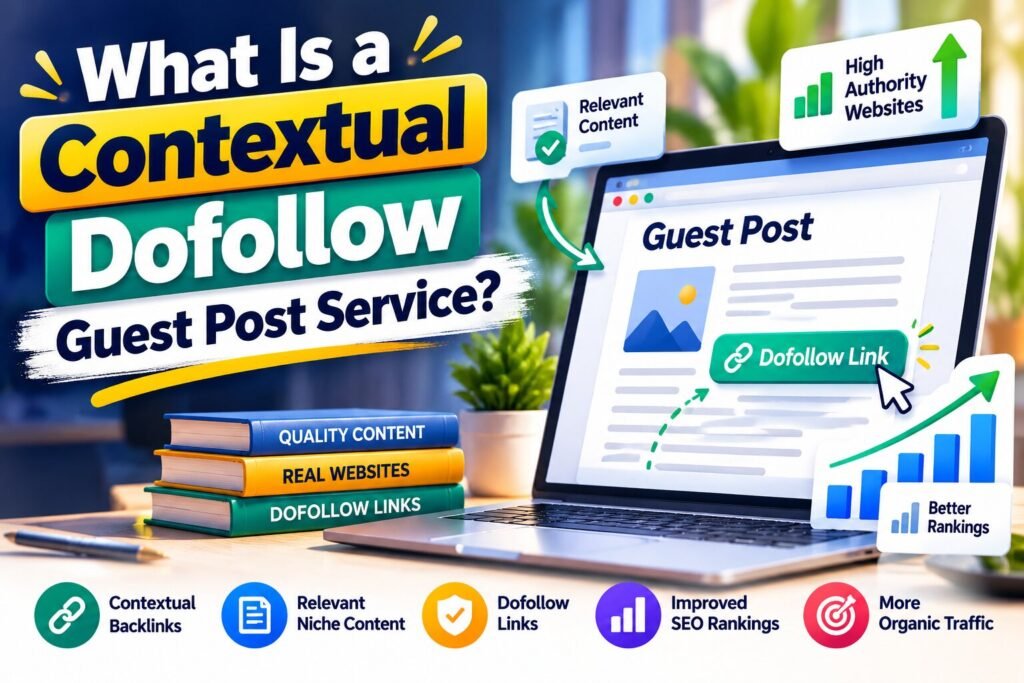
Guest post. An article you or your client writes (or a vendor writes for you) and publishes on someone else’s website.
Contextual. The link sits inside the body of the article, in a sentence that makes sense for the reader. It is not in an author bio, a footer, a sidebar, or a list of “partners.” Contextual backlinks are the ones surrounded by relevant text on a relevant page.
Dofollow. The link has no rel="nofollow", rel="sponsored", or rel="ugc" attribute. Technically, “dofollow” is not an official attribute at all. It just means the link is a plain link with nothing qualifying it.
Put together, a contextual dofollow guest post service finds publishers, writes or places an article, and gets a plain in-content link to your client’s page. A good one handles prospecting, outreach, negotiation, content, publishing, and reporting.
For agencies, the service is usually white label. The vendor stays invisible, you keep the client relationship, and the report goes out under your brand. If you want the broader context, our link building service page explains how this fits with other off-page work.
The honest part: how Google treats these links
Most vendor pages skip this section, and it is the one that matters most.
Google’s spam policies define link spam as links created primarily to manipulate rankings. The same page says that links of a commercial nature are not a violation as long as they are qualified with rel="nofollow" or rel="sponsored". Google’s guidance on how to qualify outbound links says paid placements and advertisements should carry the sponsored value.
Read those two together and the tension is obvious. If money changes hands for a link and the link is left unqualified, that is the kind of arrangement Google says it may act against. Google also states in its 2021 link spam update post that it has become much better at detecting and nullifying link schemes built on low-quality guest and sponsored posts.
What does that mean in practice?
- Many dofollow placements on real sites are earned through relationships, editorial fit, and content the publisher genuinely wants. Those are different from bulk paid placements.
- Nobody can promise that a given dofollow link will be counted, ignored, or penalized. Google decides that, not the vendor.
- The risk goes up with volume, exact-match anchors, thin articles, and sites that sell links to anyone.
A good provider will tell you this up front. If a vendor calls dofollow links “100% safe” or “Google approved,” treat that as a red flag. Nobody outside Google can promise that.
Why agencies still buy dofollow guest posts
Even with the risk, the demand is real. The reasons are practical.
Prospecting takes forever. Finding a relevant site, confirming it is real, finding the right contact, and pitching takes hours per placement. Most of those pitches get no reply.
Quality control is hard to staff. Checking traffic history, topical fit, and outbound link patterns is a skill. Many agencies do not have one person who wants that job full time.
Clients want predictable output. “Ten placements a month” is easier to sell and report on than “we’ll see what outreach produces.”
Dofollow is what clients ask for. Whether or not that is the right priority, clients see “nofollow” in a report and ask questions. A vendor who can deliver plain links in relevant content removes that conversation.
Outsourcing makes the most sense when your strength is strategy, reporting, and client management, and you want a reliable fulfillment partner behind you. It makes less sense if you have a strong in-house outreach team and mostly need better publisher lists.
How the process works
Here is what a competent provider does, in order.
- Brief and keyword mapping. You send target URLs, anchor preferences, and any industry restrictions. The vendor should push back if a target page is thin or the anchor request is too aggressive.
- Publisher selection. The vendor shortlists sites that fit the client’s topic. You should be able to approve each site before anything is written.
- Outreach and negotiation. The vendor contacts site owners or editors. Some sites accept full articles, others want pitches first.
- Content creation. The article is written to fit the host site, not stuffed with the client’s keywords. The link goes in naturally where a source or example would belong.
- Publication and verification. The article goes live. The vendor confirms the link is live, indexable, and has no unexpected attributes.
- Reporting. You get the live URL, anchor text, target page, publication date, and basic site metrics.
If a provider cannot describe each of these steps clearly, they are probably reselling from a bulk list.
What makes a placement worth having
A link’s value depends on far more than whether it is dofollow. Here are the factors that matter, roughly in order.
Topical relevance
A link to a payroll software page from a finance or small business blog makes sense. The same link from a general “write for us” site covering fashion, crypto, and pet insurance does not. Relevance helps readers and gives search engines context.
Real editorial standards
Does the site reject weak submissions? Look at the last 15 or 20 articles. If they are all thin, interchangeable, and stuffed with commercial links, the site is a link farm.
Organic visibility
Check whether the site gets organic traffic that makes sense for its size and topic, and whether that traffic has dropped sharply. A steep decline can mean a penalty or a deindexed section.
Outbound link patterns
If almost every article links out to a casino, a loan company, or a supplement store, the site sells links to anyone. That pattern is easy to spot and easy for Google to spot.
Page-level context
The page your link lives on matters. An article that is indexed, gets some traffic, and has a clear topic is better than an orphan page buried four clicks deep.
Third-party metrics
DR, DA, and similar scores are useful for comparing sites and filtering lists. They are not Google ranking factors, and they are easy to inflate. Use them as a quick filter, never as the reason to buy.
Contextual links versus other placements
| Placement type | Where the link sits | Typical value | Typical risk |
|---|---|---|---|
| Contextual (in body) | Inside a relevant paragraph | Highest, when the page is relevant | Higher if the site sells links widely |
| Author bio | At the end of the article | Lower, often treated as a signature | Lower |
| Sidebar or footer | Sitewide | Low, easy to discount | Higher for sitewide paid links |
| Niche edit (existing page) | Added to an older published article | Can be strong if the page has history | Depends on how the edit is arranged |
Niche edits and fresh guest posts do different jobs. A new guest post gives you control of the content. An edit on an older page can borrow existing authority. Many agencies use both. See our niche edits page for how we handle those.
Anchor text: where agencies go wrong
The most common mistake is asking for exact-match commercial anchors on every placement. It looks unnatural because it is unnatural. Real articles link with a mix of brand names, page titles, descriptive phrases, and bare URLs.
A reasonable approach:
- Use brand and URL anchors for most placements.
- Use partial-match and descriptive anchors for some.
- Use an exact-match keyword only when it reads naturally in the sentence.
There is no magic ratio. If the anchor would look odd in the sentence with the link removed, rewrite the sentence.
Questions to ask any provider
Before you place a first order, send these:
- Can I see and approve the site before you write the article?
- How do you decide which sites are acceptable? What do you reject?
- Do the sites carry other paid or sponsored content? Do you disclose that?
- How do you handle
sponsoredornofollowrequirements on a publisher’s side? - What happens if a link is removed or the page is deindexed?
- Who writes the content, and how is it edited?
- Do you reuse the same sites for many clients?
- What do your reports include?
- Can you place links in a niche that fits my client, or only a general mix?
Notice that “what DR do your sites have?” is not on the list. The answers to the questions above will tell you far more.
Pricing: what you can and cannot expect
Prices vary widely depending on niche, site quality, and whether content is included. I could not find a reliable, independent benchmark that would be fair to quote here, and any single number would be out of date quickly. Treat very low prices with suspicion, since real outreach and writing cost time. Instead of comparing sticker prices, compare what is included: content, revisions, replacement policy, and reporting.
Where backlinksolutions.net fits
If your agency wants a fulfillment partner rather than another list of sites, our guest post service and white label link building options are built for that. You send the brief, approve the publisher, and receive the report under your own name. We handle prospecting, outreach, and content so your team can stay on strategy and client work. We cannot promise rankings or traffic, because no one honestly can, but we can promise a clear process and transparency about every site you approve. If you want to talk through a specific client, you can request a quote.
Common mistakes to avoid
- Buying from a list without checking the actual sites.
- Using the same anchor text across many placements.
- Judging a site by DR alone.
- Ignoring outbound link patterns.
- Expecting results within days. Link effects, when they happen, usually take time to show.
- Putting every client link on the same handful of publishers.
- Treating dofollow as the only goal. A relevant nofollow or sponsored link on a real publication can still bring visitors and credibility.
Frequently asked questions
Is a dofollow guest post better than a nofollow one?
Not automatically. A dofollow link on a weak, irrelevant site can be worth less than a nofollow link on a respected, relevant publication, because the second may bring real readers and brand exposure. Dofollow matters most when the site is also relevant and credible.
Does Google penalize paid dofollow guest posts?
Google’s guidelines say paid links should be qualified with sponsored or nofollow, and Google has said it may take algorithmic or manual action on excessive unqualified sponsored and guest posting. In practice, many links are simply ignored rather than penalized, but the risk is real and rises with volume and low quality.
What is the difference between contextual and non-contextual backlinks?
A contextual backlink sits inside the body of relevant content. Non-contextual links sit in places like footers, sidebars, or bios. Contextual links generally make more sense to readers and search engines.
How many guest posts should an agency order per client per month?
There is no fixed number. It depends on the client’s site, competition, and how many natural links they already earn. Starting small and looking at the results is usually safer than committing to a high monthly volume.
Can I choose the sites where my guest posts are published?
You should be able to. A provider who refuses to share site names before publishing is asking you to take quality on trust.
What happens if a guest post link is removed later?
Ask before you buy. Reputable providers usually offer a replacement or credit within a stated period. Get the policy in writing.
Is white label guest posting allowed?
White label simply means the vendor works under your brand. It is common in agency work. The question that matters is the quality of the placements, not who is named on the report.
Conclusion
A contextual dofollow guest post service saves agencies time on prospecting, outreach, and content, and it can fit well alongside the rest of your link building. The best ones are transparent about sites, honest about risk, and focused on relevance rather than metrics. Choose based on site quality and process, ask hard questions before the first order, and start with a small batch. If you want a partner for that, our Blogger Outreach and Off-Page SEO teams are happy to look at your client’s situation and tell you plainly what makes sense.