
Ranking a website on Google requires more than adding keywords to a few pages or building a large number of backlinks. A successful SEO strategy needs relevant content, a technically sound website, a clear internal linking structure, and trustworthy signals that help search engines understand the business.
The term SEO by HighSoftware99.com is associated with publicly described SEO services and methodologies, including semantic SEO, technical optimization, topical authority, structured data, and contextual link acquisition. These areas provide a useful starting point for businesses and agencies evaluating their current search strategy. However, a provider’s stated methodology should be assessed separately from independently verified performance results.
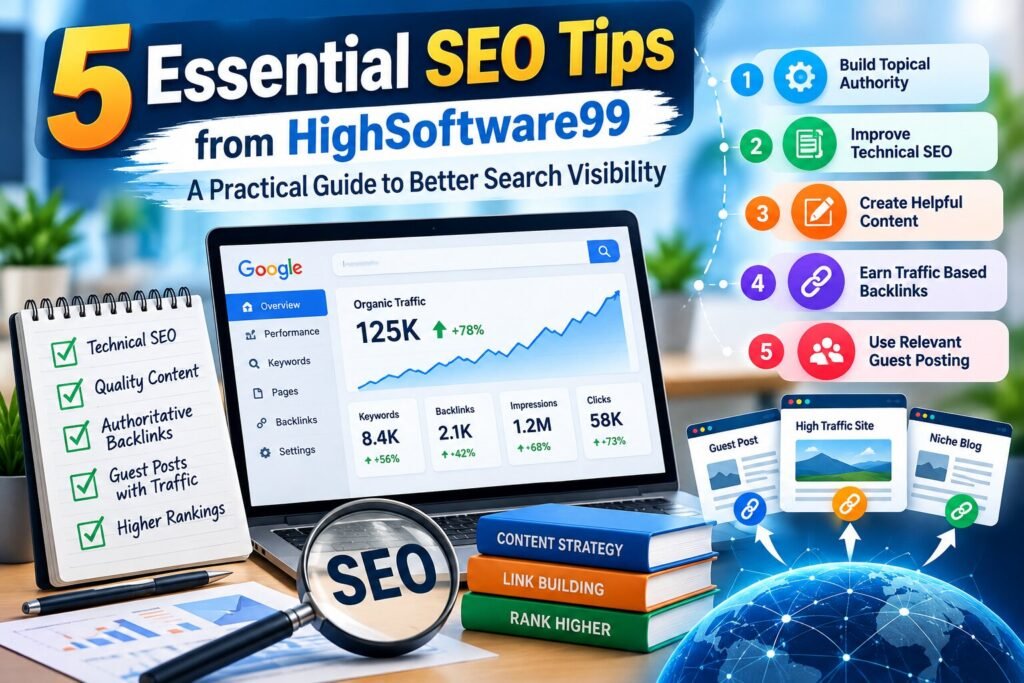
In this guide, we explore five practical SEO principles associated with these approaches and explain how to apply them to real campaigns. We also cover how SEO agencies can evaluate guest posts with traffic, select traffic based backlinks, and find organic traffic backlinks without relying exclusively on domain authority metrics.
Whether you manage your own website or outsource link building for clients, these recommendations can help you make more informed SEO decisions.
What Is SEO by HighSoftware99.com?
HighSoftware99.com and its related website, seo-byhighsoftware99.com, describe SEO services covering technical optimization, semantic content organization, local SEO, structured data, and contextual link acquisition.
The related methodology page emphasizes building topical maps, connecting related content, improving technical accessibility, and acquiring relevant backlinks. These are recognizable areas of modern SEO practice, although the specific performance claims made by a service provider should be verified through independent evidence.
You can review the methodology directly at SEO by HighSoftware99.
For businesses evaluating such a service, the important question is not simply whether a provider uses advanced terminology. It is whether its proposed work addresses measurable problems, follows appropriate search engine guidelines, and produces transparent reporting.
1. Build Topical Authority Instead of Targeting Isolated Keywords
A common SEO mistake is creating individual pages for every keyword variation without considering how those pages relate to one another.
For example, a company offering project management software might publish separate pages for project management tools, team collaboration software, task tracking, and workflow automation. If these pages overlap heavily or lack meaningful connections, the website may struggle to communicate a clear content structure.
A more organized approach begins with a central topic and expands into closely related subjects.
How to develop a topical content structure
Start by identifying the main subject your business wants to be known for. Then:
- Research the questions potential customers ask before making a purchase.
- Group related keywords according to search intent.
- Create comprehensive pages for major topics.
- Publish supporting articles that answer specific questions.
- Connect relevant pages through descriptive internal links.
- Review existing content for gaps, duplication, and overlapping search intent.
For example, a digital marketing agency could create a central guide to link building and supporting articles about blogger outreach, backlink quality, anchor text, publisher selection, and link profile analysis.
This structure gives readers a useful path through the content and helps search engines discover relationships between pages.
Why topical relevance matters for backlinks
Topical organization also influences how you evaluate external websites.
A backlink from a publication covering your client’s industry may be more contextually relevant than a link from a general website that publishes unrelated content. The decision should consider the specific page, its audience, editorial standards, and the surrounding article.
Domain Rating (DR) and Domain Authority (DA) can help with initial comparisons, but neither metric is a direct Google ranking factor. A high score alone does not establish that a website has genuine readers or provides a suitable placement.
Practical takeaway: Build content around meaningful subject relationships, then evaluate backlinks according to relevance and quality rather than chasing isolated keyword rankings.
2. Improve Technical SEO Before Scaling Content and Links
Even useful content can struggle to perform if search engines cannot access it properly or visitors encounter a poor experience.
Technical SEO involves identifying and resolving issues that affect crawling, indexing, rendering, page accessibility, and site performance.
The HighSoftware99 methodology highlights technical considerations such as page rendering, loading performance, semantic HTML, and site structure. These are reasonable areas to investigate during a technical audit, although specific targets should be adapted to the website rather than treated as universal ranking guarantees.
Essential technical SEO checks
Before investing heavily in content production or link acquisition, review the following:
| Area | What to check | Why it matters |
|---|---|---|
| Crawlability | Robots.txt rules and accessible URLs | Helps search engines access important pages |
| Indexing | Indexability, canonical tags, and noindex directives | Helps identify pages that may be excluded from search |
| Page performance | Core Web Vitals and loading issues | Supports a better user experience |
| Mobile usability | Layout, navigation, and content accessibility | Makes the site easier to use on mobile devices |
| Internal links | Broken links and important orphan pages | Helps visitors and crawlers discover relevant content |
| Structured data | Valid markup that matches visible content | Can make pages eligible for supported search features |
| Redirects | Redirect chains and broken destinations | Improves navigation and URL handling |
Google’s official SEO Starter Guide is a useful reference for understanding foundational optimization practices.
How agencies can turn audits into actionable work
A technical audit should not be a long list of warnings without priorities.
Separate findings into three groups:
- Critical issues: Problems that prevent important pages from being crawled, indexed, or accessed.
- High-priority improvements: Significant performance, navigation, or content structure issues.
- Incremental improvements: Refinements that can be implemented after more important problems are resolved.
This approach helps agencies explain the value of their recommendations and prevents clients from spending time on minor technical details while major problems remain unresolved.
Practical takeaway: Establish a technically sound foundation, measure changes, and then scale content and outreach according to the site’s needs.
3. Create Helpful Content That Matches Search Intent
Search intent describes what a person is trying to accomplish when entering a query. A searcher looking for a definition needs different information from someone comparing service providers or preparing to make a purchase.
Content that addresses the wrong intent may attract impressions without generating meaningful engagement or leads.
Match the content format to the query
Consider these examples:
| Search query | Likely intent | Useful content format |
|---|---|---|
| What is technical SEO? | Informational | Detailed explanatory guide |
| Best guest post sites with traffic | Commercial investigation | Evaluation guide or curated shortlist |
| Guest posting service pricing | Commercial investigation | Pricing explanation and service comparison |
| Buy guest post placements | Transactional | Service page with clear deliverables |
| How to check organic traffic | Informational | Step-by-step tutorial |
The exact intent should be assessed using the live search results, the wording of the query, and the needs of the target audience.
What makes SEO content genuinely useful?
Strong content answers the main question early, explains unfamiliar concepts, provides practical examples, and helps readers decide what to do next.
For a commercial article about guest posting, simply stating that backlinks are important is not enough. Readers need to know how to evaluate publishers, what traffic metrics mean, how to recognize suspicious websites, and which questions to ask a vendor.
A useful article should also avoid repeating keywords unnaturally. Google explicitly identifies keyword stuffing and manipulative link practices in its spam policies.
Use the primary keyword in appropriate places, including the title, introduction, and relevant headings. Incorporate secondary terms only when they fit the explanation.
Practical takeaway: Prioritize the reader’s actual problem. Keyword optimization should support a useful page, not replace one.
4. Evaluate Backlinks by Traffic, Relevance, and Editorial Quality
Backlink evaluation is especially important for SEO agencies that purchase placements or outsource guest posting fulfillment.
A website may report an impressive domain score while attracting very little organic search traffic. Another publisher may have a more modest authority score but a relevant audience, strong editorial standards, and pages that consistently attract readers.
This is why agencies should investigate the website itself rather than relying on a single metric.
What are traffic based backlinks?
Traffic based backlinks are backlinks acquired from websites selected partly because they receive genuine visitor traffic. The objective is to find placements that make sense in the context of the publisher’s audience and content.
However, traffic alone does not establish backlink quality. A site may receive visitors from unrelated countries, branded searches, a temporary viral article, or topics that have little connection to the client’s business.
Evaluate traffic alongside other factors.
A practical publisher evaluation framework
| Evaluation factor | What to investigate | Warning signs |
|---|---|---|
| Organic traffic | Estimated search traffic and historical trend | Sudden unexplained spikes or long-term decline |
| Traffic relevance | Countries, keywords, and topics attracting visitors | Audience unrelated to the target market |
| Topical relevance | Main subject and recent published articles | Unrelated topics mixed without a clear editorial purpose |
| Content quality | Originality, usefulness, and author credibility | Thin articles and repetitive templates |
| Backlink profile | Referring domains and suspicious link patterns | Obvious spam or manipulative networks |
| Outbound links | Commercial links and editorial practices | Excessive keyword-rich paid placements |
| Indexation | Whether important pages appear in search results | Key articles consistently missing from the index |
| Placement context | Article relevance and natural link integration | Irrelevant links inserted solely for SEO |
Traffic estimates from tools such as Ahrefs and Semrush are useful for comparing websites, but they are not the same as verified first-party analytics. Ask publishers or vendors for additional evidence when available.
How to find organic traffic backlinks
A repeatable process is more useful than selecting websites based on a spreadsheet of authority scores.
- Identify publishers covering the client’s industry.
- Review their recent articles and editorial focus.
- Check estimated organic traffic and its historical trend.
- Investigate the keywords and geographic markets bringing visitors.
- Review the site’s backlink profile and outbound linking practices.
- Confirm that the proposed article offers value to the publisher’s audience.
- Record the agreed placement, URL, anchor text, and reporting details.
This process can help agencies identify more suitable opportunities and reject questionable placements before spending money.
Remember that a backlink from a traffic-producing website does not guarantee referral visits, improved rankings, or conversions. Results depend on the placement, audience, content, and wider marketing context.
5. Use Relevant Guest Posting and Transparent Link Building
Guest posting can help businesses contribute useful material to established publications, reach relevant audiences, and build relationships within their industries.
For agencies, outsourcing this work may also reduce the time spent researching publishers, conducting outreach, negotiating placements, and coordinating content production.
The key is to evaluate the quality of the publishing opportunity instead of focusing exclusively on how many links can be delivered.
How to assess guest post sites with traffic
When evaluating guest post sites with traffic, ask these questions:
- Does the website regularly publish useful content in the client’s niche?
- Does its organic traffic come from relevant search queries?
- Are the published articles indexed and accessible?
- Do authors provide original information rather than generic filler?
- Does the website have a coherent editorial identity?
- Are outbound commercial links handled transparently?
- Can the vendor provide live placement URLs and a clear delivery report?
A strong candidate should make sense editorially, not merely appear attractive in an SEO tool.
Guest posts with traffic versus authority-only placements
| Factor | Traffic-focused placement | Authority-only selection |
|---|---|---|
| Main selection criterion | Relevant organic visibility alongside other quality checks | A high third-party authority score |
| Audience evaluation | Examines traffic sources and topic relevance | May be overlooked |
| Editorial review | Necessary for a meaningful placement | Sometimes treated as secondary |
| Potential referral value | Depends on audience fit and article visibility | Cannot be inferred from authority metrics alone |
| Main limitation | Estimated traffic does not guarantee readers will click | High authority does not prove quality or relevance |
For most agency workflows, traffic should be one part of a broader quality assessment rather than the sole approval criterion.
Understand Google’s rules on paid placements
Google’s guidance matters when guest posts involve payment or another commercial arrangement.
Its documentation on qualifying outbound links recommends using rel="sponsored" for paid placements. rel="nofollow" remains an acceptable alternative for qualifying these links.
Google also identifies buying or selling links intended to manipulate rankings, including certain guest posts with optimized links, as a link spam concern.
Agencies should therefore discuss link attributes and publishing terms with clients and publishers before a campaign begins. Do not promise that a paid placement will pass ranking credit or produce a particular Google position.
When outsourcing guest posting makes sense
Outsourcing can be useful when an agency has more client work than its internal team can fulfill efficiently.
A dependable fulfillment partner may help with:
- Publisher prospecting and initial website screening.
- Blogger outreach and placement coordination.
- Content preparation and editorial communication.
- Placement tracking and live URL reporting.
- Quality checks against the agency’s requirements.
- White-label delivery under the agency’s brand, where agreed.
Before engaging a vendor, confirm its pricing structure, expected delivery times, replacement policy, reporting format, and criteria for approving publishers.
For agencies seeking support with fulfillment, backlinksolutions.net is a relevant place to explore guest posting and link-building services. Assess the scope and quality controls of any proposed service against your client’s requirements rather than assuming every package is suitable.
A Practical SEO Workflow for Agencies
The five principles above work best as part of a consistent process.
Use this workflow when planning a new campaign or reviewing an existing client account.
Step 1: Establish a baseline. Record current organic performance, important landing pages, technical issues, and the client’s commercial objectives.
Step 2: Map topics and intent. Identify priority services, supporting topics, relevant keywords, and content gaps.
Step 3: Resolve technical problems. Prioritize issues that prevent search engines or users from accessing important pages.
Step 4: Improve the content. Update pages that do not answer the intended query, and create new material where genuine gaps exist.
Step 5: Evaluate publishers. Shortlist relevant websites using organic visibility, editorial quality, traffic sources, and outbound link patterns.
Step 6: Coordinate placements carefully. Agree on content requirements, target pages, appropriate anchor text, and link qualification before publication.
Step 7: Report outcomes honestly. Track completed placements, referral activity where measurable, organic search changes, and relevant conversions. Avoid attributing every performance change to backlinks alone.
Questions to ask an SEO or guest posting provider
Before approving a service, ask the provider:
- How do you select websites for a campaign?
- Can you show estimated traffic trends and relevant ranking keywords?
- How do you check topical relevance and suspicious outbound links?
- Are placements editorially reviewed before approval?
- Which link attributes will publishers use?
- What happens if an article is removed or a placement fails the agreed requirements?
- What reporting will we receive, and which outcomes are actually guaranteed?
These questions help separate a clearly defined fulfillment process from an offer built around impressive metrics or unsupported ranking promises.
Frequently Asked Questions
1. What does SEO by HighSoftware99.com mean?
The term refers to publicly described SEO services and methodologies associated with HighSoftware99, including semantic content organization, technical optimization, structured data, and contextual link acquisition. Evaluate the provider’s specific claims using verifiable deliverables and independent performance evidence.
2. Are traffic based backlinks better than backlinks from high-DR websites?
Not automatically. Organic traffic can indicate that a website attracts search visitors, while DR and DA provide third-party estimates of link authority. Neither measure alone establishes placement quality. Consider relevance, traffic sources, content, editorial standards, and the site’s backlink profile together.
3. How can I find guest post sites with traffic?
Start with publishers in the client’s niche, then investigate their organic traffic trends, ranking keywords, audience geography, recent articles, and outbound links. Use SEO tools for initial screening and request first-party evidence when available.
4. Do organic traffic backlinks guarantee higher Google rankings?
No. A website’s traffic does not guarantee that a backlink will improve rankings. Google may ignore links, and paid links intended to manipulate rankings can violate its spam policies. Evaluate links as part of a broader, policy-aware SEO strategy.
5. How many guest posts should an agency order each month?
There is no universal number that suits every client. The appropriate volume depends on the budget, industry, publishing opportunities, content quality, and campaign objectives. Prioritize relevant, well-vetted placements over arbitrary monthly targets.
6. Is outsourcing guest posting suitable for small SEO agencies?
Yes, it can be useful when internal resources are limited or demand fluctuates. Before outsourcing, check publisher selection criteria, pricing, delivery expectations, reporting, and quality assurance. Make sure the provider’s process matches your agency’s standards.
7. What should an agency check before buying guest post placements?
Review the website’s organic traffic, topical relevance, content quality, backlink profile, indexation, and outbound link patterns. Confirm the placement terms and applicable link attributes before payment, and avoid providers that promise guaranteed Google rankings.
Conclusion
SEO by HighSoftware99.com provides a useful starting point for examining semantic SEO, technical optimization, content structure, and contextual link acquisition. The more important lesson is to evaluate each recommendation against sound SEO principles and verifiable results.
Build content that answers real questions, resolve technical issues, and assess backlinks using relevance, editorial quality, and genuine organic visibility. When selecting guest posts with traffic or organic traffic backlinks, remember that traffic estimates and authority scores are evidence to investigate, not guarantees of success.
For SEO agencies that need help managing publisher outreach and placement fulfillment, explore the services available through Backlink Solutions. Choose a process that supports transparent reporting, appropriate quality checks, and realistic client expectations.